
Mitsubishi L200 Timing Belt: Intervals, Fitment & Warning Signs
The 4D56 engine has a belt requiring scheduled replacement, while the 4N15 uses a chain instead — worth checking your specific engine code rather than assuming based on year alone.
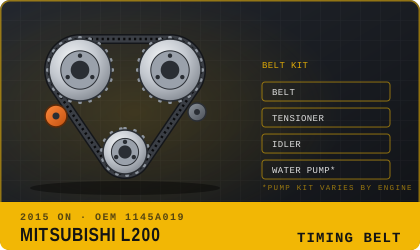 Illustration for editorial purposes
Opens live listings in a new tab.
OEM Part Number: 1145A019
| 2.5 4D56 diesel (2005-2015), genuine timing belt | Mitsubishi OEM: 1145A019 (also referenced as MD300473, MD300470 for earlier builds) |
|---|
Service deadlines for the L200: why a late job costs more
On the Mitsubishi L200, there's a shorter list of maintenance items where skipping the schedule is risky, and this is near the top of it. Failure here tends to cause damage well beyond the part itself on affected engines, which is why sticking to the interval matters more than it does elsewhere on the car.
Keeping valve timing perfectly matched to piston position is the Mitsubishi L200's timing belt or chain's job, synchronising the camshafts and crankshaft. On "interference" engines — a common design — a belt failure means pistons and valves can physically collide, causing serious damage inside the engine.
Watch: Replacing ItExact model and engine — the 2.5 4D56 belt change on the 2005–2015 L200. The later 2.4 DI-D (4N15) is chain-driven.
Which L200 engines drive the cams by belt and which by chain
| 2005–2015, 2.5 4D56 diesel | Timing belt — see genuine reference above |
|---|---|
| 2015–present, 2.4 DI-D diesel (4N15) | Timing chain — Mitsubishi moved to chain for the current generation |
Opens live listings in a new tab.
The habit that saves money on the L200: read the engine code
Before assuming a single answer applies to your L200, the specific engine code matters enormously here, since different generations use entirely different timing systems even when the model years might otherwise seem similar. The 4D56 engine, used on the earlier generation, has a timing belt requiring scheduled replacement, while the 4N15 engine, used on later models, uses a timing chain instead. It's worth checking your specific engine code on the identification plate or documentation, rather than assuming based on your registration year alone, since getting this wrong could mean missing a necessary belt change or unnecessarily worrying about a component your engine doesn't even have.
Note too that timing chain or belt work on these engines has been documented as requiring specialised tools that not every independent garage has access to, meaning a trip to a Mitsubishi specialist or main dealer may be necessary even if your regular mechanic is otherwise very capable.
Warning signs, DIY difficulty and aftermarket adviceThese are the same regardless of make or model — see our full Timing Belt Guide for symptoms to watch for, confirming fitment against your VIN, and which aftermarket brands are worth trusting.
The same part on other modelsThe same part, covered across other Mitsubishi models.