
Mitsubishi Mirage Spark Plugs: Intervals, Fitment & Warning Signs
On the Mirage, swapping plugs between two cylinders genuinely helps isolate whether a misfire is caused by the plug or something else entirely.
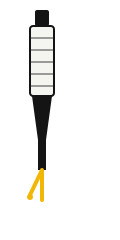 Illustration for editorial purposes
Opens live listings in a new tab.
OEM Part Number: confirm via engine code — aftermarket NGK 97362 / Bosch 0 242 235 769
| Petrol engines in this generation | 1.0 (A05A) 69/71 HP; 1.2 71/76 HP; 1.2 (A03A) 75/78/79/80 HP; 1.0 Bifuel 71 HP; 1.2 LPG (A03A) 71 HP |
|---|---|
| Spark plugs (aftermarket) | NGK 97362 (iridium, M14x1.25, 16 mm hex, 26.5 mm reach); NGK 95622 (iridium, gap 1.1 mm, M14x1.25, 16 mm hex); NGK 1496 (laser line, LPG, 60,000 km interval); Denso IKH20TT (iridium/platinum, M14x1.25, 26.5 mm reach); Denso FK20HR11 (iridium/platinum, M14x1.25, 26.5 mm reach); Bosch 0 242 235 769 (gap 1.1 mm, M14x1.25, 16 mm hex); Champion CCH9006 (iridium, gap 1.0 mm, M14x1.25, 16 mm hex) |
| Genuine (OE) numbers quoted | Denso FK20HR11 is quoted against 90919-01247; Kamoka 7100052 against 22401AA750 |
| Fitment notes | Iridium plugs with a 26.5 mm reach and a 1.0-1.1 mm gap are the main family for the 1.0 (A05A) and 1.2 (A03A) three-cylinder engines; shorter 19 mm-reach Bosch and Ridex plugs also appear. The Denso OE number is a Toyota-type number, so treat the cross-reference with caution. |
Mitsubishi Mirage Spark Plugs: A Cheap Part That Causes Expensive-Feeling Problems
On the Mitsubishi Mirage, spark plug wear tends to creep in quietly — idle gets a little rougher, throttle response softens slightly — the kind of symptoms that get blamed on almost anything else under the bonnet. Given how cheap the part itself is, it's an easy one to put off for longer than makes sense.
Mitsubishi Mirage Spark Plugs: What They Do
Inside each cylinder of the Mitsubishi Mirage, spark plugs ignite the compressed fuel-air mixture, and their condition has a direct effect on combustion efficiency, fuel economy and how smoothly the engine runs. Petrol engines can't function without them; diesels don't use spark plugs, relying on compression alone to ignite fuel.
Mitsubishi Mirage Spark Plugs: Generations & Spark Plug Count
| Diesel variants, where fitted | Not applicable — diesel engines use compression ignition and have no spark plugs at all |
|---|---|
| Petrol variants (all trims) | 4 spark plugs — one per cylinder |
Mitsubishi Mirage Spark Plugs: Watch: Replacing It
Alternative: gT64wB6xCsE (2015 Mirage 1.0).
Opens live listings in a new tab.
A Genuinely Useful, Real Diagnostic Technique Worth Trying — Mitsubishi Mirage Spark Plugs
If you're chasing a single-cylinder misfire after a plug replacement, this is genuinely worth trying: swapping the plugs between two cylinders and seeing whether the misfire follows the plug to its new cylinder is a genuinely useful, classic diagnostic technique. If the misfire moves with the swapped plug, the plug itself is likely the culprit; if it stays on the original cylinder, it points toward the coil, wiring, or an injector instead.
It's also genuinely worth knowing an honest warning worth taking seriously: the relationship between Mitsubishi's electronics and aftermarket ignition components can be genuinely unpredictable, worth bearing in mind when choosing replacement coils specifically.
Mitsubishi Mirage Spark Plugs: Warning Signs, DIY Difficulty & Aftermarket Advice
These are the same regardless of make or model — see our full Spark Plugs Guide for symptoms of worn plugs, why matching your exact plug specification matters, and trusted brands to buy from.
More Mitsubishi Spark Plugs
The same part, covered across other Mitsubishi models.