
Renault Clio Engine Mount: Specs, Fitment & Common Faults
A worn mount can be an effect of an underlying rough-running engine, not the original cause — plus a persistent dCi mount issue dealers have struggled to permanently fix.
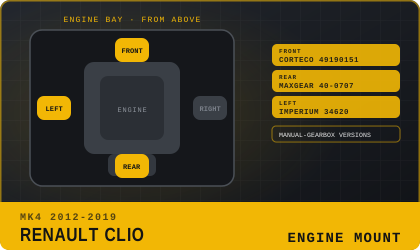 Illustration for editorial purposes
Opens live listings in a new tab.
OEM Part Number: confirm via VIN
Aftermarket mountings: Lemförder 4406301 / Corteco 49190151
| Engine Mount — Rear (aftermarket) | Maxgear 40-0707, Tedgum TED50390 |
|---|---|
| Engine Mount — Left (aftermarket) | Original Imperium 34620, Lemförder 4406301 (manual) |
| Engine Mount — Front (aftermarket) | Corteco 49190151 |
| Genuine (OE) number | Not quoted in the catalogue listings — mounts differ by engine and gearbox, so order the genuine ones against your VIN |
| Fitment notes | The listing above shows examples for the engines checked; petrol, diesel, manual and automatic versions often use different mounts, and cars usually have more than one mount. |
Fix the cause, then the Clio's mountings
Before replacing mounts, it's worth considering something counter-intuitive: worn engine mounts aren't always the original cause of vibration — sometimes they're the effect of it. If the engine itself isn't running perfectly smoothly (an underlying misfire, ignition fault, or rough idle), this excess vibration transmitted through the mounts over time can accelerate their wear, meaning you could replace the mounts, only for them to wear out again quickly if the actual root cause — the engine not running smoothly — was never addressed. If your idle isn't smooth and steady, it's worth investigating why before assuming worn mounts are the whole story.
Also, this is a well-documented, persistent issue on dCi diesel models — one owner described it directly as "the engine mount problem that plagues numerous Clio dCi owners," with dealers reportedly aware of the issue but struggling to find a lasting fix even after repeated attempts. If you're facing repeat mount failures on a dCi engine despite proper replacement, you're likely not alone, and it's worth researching which specific revised mount or aftermarket alternative other owners have found lasts, rather than assuming you've simply had bad luck with parts.
Watch: replacing it
The job the mountings do on the Clio
Engine mounts secure the engine and transmission to the chassis while absorbing vibration and movement, preventing that vibration from transferring directly into the cabin. Most versions of the Clio use several mounts working together — typically at least one on each side of the engine plus a torque mount — and a single failed mount can throw off the whole assembly's balance.
Opens live listings in a new tab.
What wear feels like on the Clio, and what to fit
These are the same regardless of make or model — see our full Engine Mount Guide for warning signs to watch for (including some make-specific quirks in how they show up), confirming fitment against your VIN, and which aftermarket approach is worth trusting.
The same part on other modelsThe same part, covered across other Renault models.