
Renault Megane Front Suspension Strut: Specs, Fitment & Common Faults
On the Megane, a detail for DIY wishbone work: tightening angle matters critically to avoid a persistent creak returning.
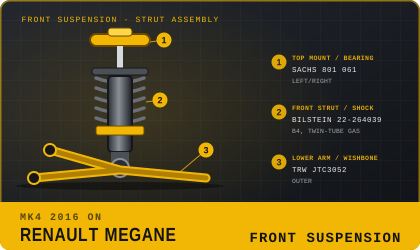 Illustration for editorial purposes
Opens live listings in a new tab.
OEM Part Number: confirm via VIN
Aftermarket front struts: Bilstein 22-264039 / KYB 3348087
| Front strut / shock absorber (aftermarket) | Bilstein 22-264039 (B4, twin-tube gas); Bilstein 22-266378 (B8 Performance Plus); KYB 3348087 and 3348092 (Excel-G); KYB 3358044 (Excel-G); Daco 453021 / 453022; Monroe 742283SP (twin-tube gas, axle not stated) |
|---|---|
| Front lower arm / wishbone (aftermarket) | LH TRW JTC3052 (outer); LH Delphi TC3899 (with ball joint, 450 x 415 x 76 mm); LH febi 181392 (with ball joint, 22 mm cone); LH Mapco 59173; LH Topran 701 962; RH TRW JTC3051; RH Delphi TC3900 |
| Top mount / strut bearing (aftermarket) | Sachs 801 061 (left/right, without bearing); Lemförder 42543 01 (left/right); febi 103189 (elastomer, no bearing); Original Imperium 72400 (with bearing); SNR KB668.48 (with bearing); KYB SM1042 |
| Genuine (OE) numbers quoted | Sachs 801 061 and Lemförder 42543 01 mounts 54 32 069 68R, 98 004 797 80; Sasic 2654043 and Original Imperium 72400 mounts 543206968R; Sasic 2654045 mount 543258271R; none quoted for front shocks or arms |
| Fitment notes | No Sachs front strut listed; B8 Performance Plus is the only uprated option; no side split on struts. |
Ride height and torque: wishbone fitting on the Megane
If you're replacing a wishbone yourself, this is worth getting right: the angle of the wishbone matters critically when tightening its mounting bolt — one case saw a persistent creak return weeks after a wishbone replacement, eventually traced to the bolt having been tightened while the suspension was unweighted rather than at proper ride height. Tightening rubber bushes at the wrong angle pre-stresses the rubber, causing exactly this kind of slow-developing, hard-to-diagnose noise. Torquing the bolt with the car's full weight on the wheels rather than with the suspension hanging free is worth getting right.
How the Megane's suspension soaks up the road before you feel it
Before you feel a single bump or pothole in the Renault Megane's cabin, it's already passed through these parts — which is exactly why wear tends to present as several vague, overlapping symptoms rather than one clear-cut fault. A methodical check outperforms guesswork here.
Watch: replacing itLower arm

How the strut assembly holds up the Megane
The Renault Megane's front suspension combines the shock absorber and spring mount into a single strut assembly, which is what governs how the car settles after a bump. A worn one lets that bounce continue longer than it should, and it can wear tyres unevenly if ignored.
Opens live listings in a new tab.
These are the same regardless of make or model — see our full Front Suspension Strut Guide for symptoms of worn bushings and ball joints, confirming fitment against your VIN, and rubber vs polyurethane guidance.
The same part on other modelsThe same part, covered across other Renault models.