
Renault Twingo Rear Springs: Specs, Fitment & Common Faults
Worth confirming first: drivetrain and left/right side both affect which rear spring fits.
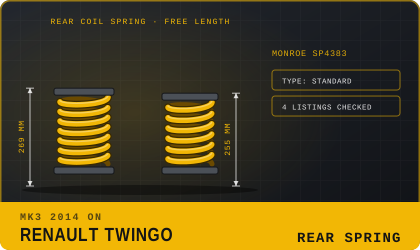 Illustration for editorial purposes
Opens live listings in a new tab.
OEM Part Number: confirm via VIN
Aftermarket coils: Monroe SP4383 / Sachs 994951
| Rear coil springs (aftermarket) | Monroe SP4383 (269 mm); Monroe SP4384 (255 mm); Monroe SP4379 (268 mm); Sachs 994951 (standard, 268 mm) |
|---|---|
| Genuine (OE) numbers quoted | None quoted in the catalogue listings — the genuine spring varies by engine, suspension type and body style, so order it against your VIN |
| Front-wheel drive, standard rate | a different spring from the AWD version below — confirm drivetrain and side before ordering |
| AWD | A different spring from the front-wheel-drive version, reflecting the different rear axle layout |
Replacing just one Renault Twingo rear spring is a false economy: pairing it with an old, sagged spring on the other side produces uneven ride height and a noticeable handling bias.
Rust and fatigue in the Twingo's coils
Months of gradual sagging with barely any symptom beyond a marginally lower ride height is the usual pattern for the Renault Twingo's rear spring, right up until it fails suddenly at the coil's end with a clunk. If one rear corner looks lower than the other, that's the clue worth acting on.
This video is of an earlier generation of the same model; the job is similar but the spring seats and fixings can differ slightly.

The job of each coil at the back of the Twingo
The Renault Twingo's rear end weight rests on the coil spring, which also absorbs the initial shock of a bump — a separate function from the shock absorber, not a replacement for it. Left sagged or broken, it lowers ride height, potentially skews headlight aim, and can become an MOT failure in severe cases.
Opens live listings in a new tab.
What to look for on the Twingo, and whether to fit coils yourself
These are the same regardless of make or model — see our full Rear Springs Guide for symptoms of a failing spring, confirming fitment against your VIN, and OEM vs aftermarket guidance.
The same part on other modelsThe same part, covered across other Renault models.