
Renault Twingo Timing Belt: Intervals, Fitment & Warning Signs
On the Twingo, a specific, genuine root cause explains why timing chain failures on the 1.2 TCe engine keep recurring even after a proper replacement.
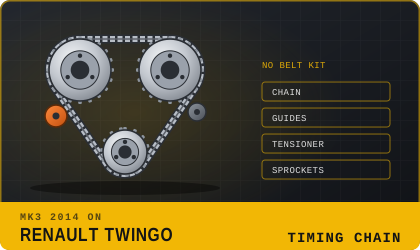 Illustration for editorial purposes
Opens live listings in a new tab.
Fitment Summary: Chain-Driven Engines
| 1.0 SCe 70 (H4D) | Timing chain — no belt kit required |
|---|---|
| 0.9 TCe 90 (H4Bt) | Timing chain — no belt kit required |
| Twingo Electric (2020 on) | No engine, no timing component |
A repeating chain failure on the TCe, and its root cause
If your car has the 1.2 TCe engine (introduced 2012, shared across the Renault-Nissan alliance including the Clio, Captur, Megane, Nissan Qashqai/Juke, and Dacia Duster/Sandero), this engine has a well-documented, recurring timing chain failure problem — one that persists even when a workshop has already fitted a genuine OEM or quality aftermarket replacement chain kit. The specific, confirmed root cause is a small oil jet responsible for lubricating the chain directly, which is highly susceptible to becoming clogged with soot contamination in the engine oil. Once this jet clogs, the chain simply doesn't receive enough lubrication, accelerating wear and leading to premature failure again.
A cost benchmark worth knowing: aftermarket timing chain kits for this engine family are available from around £69, though labour to fit correctly (including addressing the oil jet) will be the larger part of the overall bill.
Service deadlines for the Twingo: why a late job costs more
Very few parts on the Renault Twingo carry as much risk for neglect as this one does. When it fails on the affected engines, the damage typically isn't contained to the part itself, which is exactly why keeping to schedule matters more here than almost anywhere else.
Watch: Replacing ItThe same 0.9 TCe engine as the Twingo, filmed in a Dacia — chain, not belt, so this is only needed if the chain has stretched.

Exact synchronisation between camshaft and crankshaft rotation — that's what the Renault Twingo's timing belt or chain delivers, timing valve movement to piston position down to the degree. Many engines use an "interference" design, meaning a snapped belt allows pistons and valves to collide, causing serious damage inside the engine.
Whether belt or chain drives the Twingo's engines
| Mk1/Mk2 (1993–2014), petrol | Timing belt — conventional dry belt |
|---|---|
| Mk3 (2014–present), rear-engined, shared with Smart ForFour | Timing chain — see confirmation above |
Opens live listings in a new tab.
These are the same regardless of make or model — see our full Timing Belt Guide for symptoms to watch for, confirming fitment against your VIN, and which aftermarket brands are worth trusting.
The same part on other modelsThe same part, covered across other Renault models.