
Seat Arona Front Bumper: Fitment, Sensors & Common Damage
On the Arona, all parking sensors are wired in series — meaning a single failed sensor disables the entire system, not just its own detection zone.
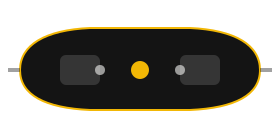 Illustration for editorial purposes
Opens live listings in a new tab.
Seat Arona Front Bumper: OEM Part Number
A Genuinely Important Fact: Sensors Are Wired in Series — Seat Arona Front Bumper
A genuinely important, distinct fact worth knowing before assuming a widespread wiring fault: the parking sensors on this platform are wired in series, meaning if just one individual sensor fails — even from something as minor as a stone chip — the entire system can stop working completely, front and rear together, rather than just losing detection at that one specific point. This explains why a seemingly total parking sensor failure can sometimes be traced back to a single damaged sensor rather than a fault with the whole wiring loom or control module.
Seat Arona Front Bumper: More Than Just a Plastic Panel
The Seat Arona's front bumper routinely integrates parking sensors, adaptive cruise control radar, and fog light housings, which means replacing it after even minor impact damage often involves more than a straightforward swap.
Seat Arona Front Bumper: What It Does
Beyond absorbing minor impacts, the front bumper on higher trims of the Arona often houses parking sensors, the radar sensor used for adaptive cruise control, and fog lights. A bumper that looks compatible can still be missing the correct cutouts or mounting provisions for your specific trim's equipment.
Seat Arona Front Bumper: Generations, Derivatives & Colour
| Standard trims | Dark Camouflage, Asphalt Blue, Sapphire Blue, plus a choice of three contrast roof colours (Midnight Black, Magnetic Tech, Candy White) |
|---|---|
| FR/Style trim | Candy White is genuinely restricted to fleet orders only, the same pattern as the Ibiza — not available to retail customers; different front bumper with reflex silver or black lower spoiler than other trims |
Opens live listings in a new tab.
Seat Arona Front Bumper: Common Damage, DIY Difficulty & Aftermarket Advice
These are the same regardless of make or model — see our full Front Bumper Guide for common damage types to check for, confirming fitment against your VIN, and the sensor-calibration risk with cheap aftermarket covers.
More Seat Front Bumper
The same part, covered across other Seat models.