
Skoda Superb Timing Belt: Intervals, Fitment & Warning Signs
On the Superb, Skoda's own service advice on timing belt intervals has changed over time — worth treating that extended interval with real caution.
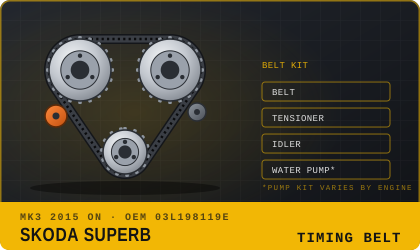 Illustration for editorial purposes
Opens live listings in a new tab.
OEM Part Number: 03L198119E
| 2.0 TDI common-rail (CJAA/CBEA), genuine kit — belt, tensioner, idler roller | Genuine VAG reference: 03L198119E (also referenced as 03L198119N) — 120,000 mile interval, shared across Golf, Jetta, A3, A4, Tiguan, Beetle |
|---|
A shifted interval policy on the Superb
Worth knowing before assuming a longer interval automatically applies to your car: Skoda's own official guidance on timing belt replacement intervals for TSI petrol engines has shifted over time, and not always consistently. One account describes a Skoda service manager confirming the policy had changed to inspection-only until 150,000 miles or 10 years; another owner reports being told the 1.5 TSI's official interval moved from 5 years/50,000 miles to 144,000 miles with no time limit stated at all when they contacted Skoda directly. This is a significant change from the original, more conservative figures, and independent specialists remain divided on how much to trust it.
How the Superb's engine range divides between belt and chain
| Mk2/3T (2008–2015), TSI/FSI petrol | Timing chain — no scheduled replacement interval |
|---|---|
| Mk2 vRS (2009–2015), 1.8/2.0 TSI petrol | Timing chain — same EA888 family as the contemporary Octavia vRS |
| Mk2/3T & Mk3/B8 (2008–present), TDI diesel | Timing belt — see genuine reference above |
| Mk3/B8 (2015–present), 1.5/2.0 TSI petrol & vRS | Timing chain — no scheduled replacement interval |
What a missed change date can mean
This is one of the rare maintenance items on the Skoda Superb where skipping the schedule risks serious consequences. On the engines affected, a failure here tends to cause damage well beyond the part itself, making the interval more important than on almost any other component.
The Skoda Superb's timing belt or chain's whole purpose is keeping the camshafts and crankshaft turning in exact synchronisation, so valves open and close at precisely the right moment relative to the pistons. On "interference" engines, a common design, a failed belt lets pistons and valves collide, with serious internal damage the result.
Opens live listings in a new tab.
This covers the 2.0 TDI shared across the VAG group. Petrol TSI engines are chain-driven and don't need this procedure — check which your car has above.
Warning signs, DIY difficulty and aftermarket adviceThese are the same regardless of make or model — see our full Timing Belt Guide for symptoms to watch for, confirming fitment against your VIN, and which aftermarket brands are worth trusting.
The same part on other modelsThe same part, covered across other Skoda models.