
Subaru Outback Rear Shock Absorber: Specs, Fitment & Common Faults
Worth knowing: the rear shock and spring are commonly sold together as a complete assembly on Subaru's platform, not always as separate parts.
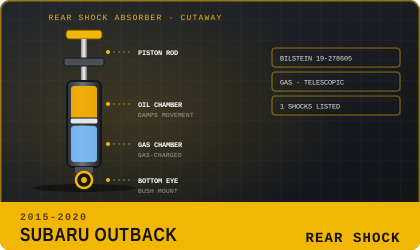 Illustration for editorial purposes
Opens live listings in a new tab.
OEM Part Number: confirm via VIN
Aftermarket rear dampers: Bilstein 19-278605
| Rear shock absorbers (aftermarket) | Bilstein 19-278605 (gas) |
|---|---|
| Genuine (OE) numbers quoted | None quoted in the catalogue listings — the genuine damper varies by engine, suspension type and body style, so order it against your VIN |
| Standard, right | a different part number from the left-side shock — Subaru's own parts catalogue lists these separately |
| Standard, left | A different reference from the right-side shock above |
| Turbo, where fitted | A different shock from the naturally aspirated version, confirmed as separate part numbers |
The Subaru Outback's shock absorbers should always be replaced in pairs.
Why turbo versions of the Outback take their own dampers
Worth knowing: Subaru's own parts catalogue lists left and right rear shocks as separate, non-interchangeable references, and turbo variants (where offered) use a different shock from naturally aspirated versions.
Why the Outback's rear end gets overlooked until it wallows
It's easy to focus entirely on the Subaru Outback's front suspension, since it also does the steering, but the rear shocks age just the same — often with subtler symptoms that get dismissed as road noise right up until they can't be ignored.

How the Outback keeps its back wheels planted
The rear shock absorber controls how quickly the rear suspension compresses and rebounds over bumps. A worn rear shock lets the back of the car bounce excessively after a bump instead of settling quickly.
Opens live listings in a new tab.
These are the same regardless of make or model — see our full Rear Shock Absorber Guide for symptoms of a worn shock, confirming fitment against your VIN, and OEM vs aftermarket guidance.
The same part on other modelsThe same part, covered across other Subaru models.