
Subaru Outback Timing Belt: Intervals, Fitment & Warning Signs
On the Outback, a brief rattle on cold start lasting a few seconds is normal on this engine family — plus an account of a full warranty replacement where the noise still returned.
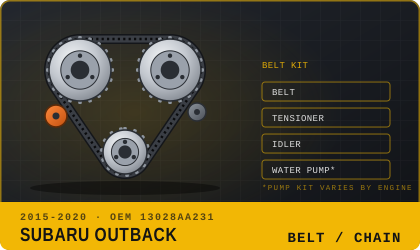 Illustration for editorial purposes
Opens live listings in a new tab.
OEM Part Number: 13028AA231
| 2006-2012, 2.5L SOHC non-turbo, genuine belt kit | Subaru OEM: 13028AA231 (belt), 13073AA142 (idler), 13033AA042 (tensioner) — shared across Forester, Impreza, Outback, Legacy |
|---|---|
| Current generation (2017 onwards), genuine timing chain | Subaru OEM: 13143AA23A — spans 2.0L, 2.4L, 2.5L engines |
Cam drive by engine on the Outback
| BP/BL (2003–2009), 2.5 naturally-aspirated | Timing chain — no scheduled replacement interval |
|---|---|
| BR (2009–2014), 2.5 naturally-aspirated & 2.5 turbo | Chain (NA) / belt (turbo) — genuine split within the same model year, see warning above |
| BS (2014–2019) & BT (2019–present), all engines | Timing chain — see OEM confirmation above |
Why the Outback change interval deserves a diary entry
Skipping this one on the Subaru Outback carries more downside risk than almost any other maintenance item on the car. On engines where it fails, the damage typically spreads well beyond the part itself, which is exactly why the replacement schedule matters more here than almost anywhere else.
On the Subaru Outback, precise synchronisation between the camshafts and crankshaft is what the timing belt or chain provides, making sure valves open and close at exactly the right point relative to piston position. Many engines use what's called an "interference" design, where a belt failure lets pistons and valves collide, causing serious internal damage.

Opens live listings in a new tab.
A few seconds of rattle at cold start
If you're hearing a brief rattle on cold starts that lasts only a few seconds, this is a widely documented, common characteristic across this engine family, caused by the hydraulic chain tensioner needing oil pressure to fully take up slack after the car has sat overnight. Once oil pressure builds, typically within one to five seconds, the rattle disappears — confirmed as normal by multiple owners and dealer technicians alike.
The brief cold-start rattle described above is different from a persistent, continuous knock occurring under load at lower revs. If you're facing this more serious, continuous pattern, it's worth getting a proper, specific diagnosis rather than accepting vague, alarming language about the car being near the end of its life without clear evidence.
Watch: Replacing ItThis covers the turbo variant, which uses a belt. Naturally-aspirated chain-driven versions of the same generation don't need this procedure — check which your car has above.
Warning signs, DIY difficulty and aftermarket adviceThese are the same regardless of make or model — see our full Timing Belt Guide for symptoms to watch for, confirming fitment against your VIN, and which aftermarket brands are worth trusting.
The same part on other modelsThe same part, covered across other Subaru models.