
Suzuki Baleno Radiator: Specs, Fitment & Common Faults
On the Baleno, coolant from the air conditioning drain pipe points toward a leaking heater core rather than the radiator.
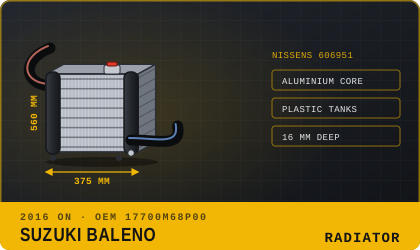 Illustration for editorial purposes
Opens live listings in a new tab.
OEM Part Number: 17700M68P00
As quoted in catalogue listings, confirm via VIN. Aftermarket units: Nissens 606951 / NRF 550298
| Radiators (aftermarket) | Nissens 606951 (375 x 560 x 16 mm, aluminium core with plastic tanks, fits 1.2 and 1.2 SHVS Hybrid 66 kW K12C); NRF 550298; Van Wezel 52012712; AKS Dasis 320002N; Hart 646 593. |
|---|---|
| Core sizes & variants | This 375 x 560 mm radiator is listed for the 1.2 Dualjet in both plain and mild-hybrid form. |
| Genuine (OE) numbers quoted | 17700M68P00 |
| Fitment notes | Supplied with gaskets, seals and a sealing lid; inlet and outlet are 20.5 mm. No Valeo, Denso or Mahle equivalents are listed for this car. |
Why a failing cooling pack puts the whole Baleno engine at risk
Unglamorous as it is, the Suzuki Baleno's cooling system sits behind nearly every serious engine failure that isn't just ordinary wear — and one that went unaddressed for too long. Noticing early warning signs here is a small cost against a potentially very large one.
Core, fins and fan: the Baleno's cooling explained
On the Suzuki Baleno, engine coolant sheds its heat into the passing air via the radiator, which is what keeps engine temperature in a safe working range. On automatics, it frequently pulls double duty cooling the transmission fluid through its own internal circuit — a detail that makes getting the exact part number right especially important.
Swift generation not confirmed; Baleno hits were fan and coolant videos only
Opens live listings in a new tab.
What coolant at the AC drain means on the Baleno
If you notice coolant coming from the air conditioning system's drain pipe, rather than from underneath the car generally, this is a specific sign pointing toward a leaking heater core rather than the radiator itself — worth checking this detail before assuming the radiator is at fault.
Bear in mind that a persistent overheating issue appearing only while driving, rather than at idle, doesn't always mean an external leak — in at least one case, the radiator itself wasn't achieving good coolant flow through its internal passages despite no external leak being visible.
Faults, DIY difficulty and aftermarket adviceThese are the same regardless of make or model — see our full Radiator Guide for the three common failure modes, confirming fitment against your VIN, and OEM vs aftermarket guidance.
The same part on other modelsThe same part, covered across other Suzuki models.