
Suzuki Vitara Radiator: Specs, Fitment & Common Faults
On the Vitara, coolant from the air conditioning drain pipe points toward a leaking heater core rather than the radiator.
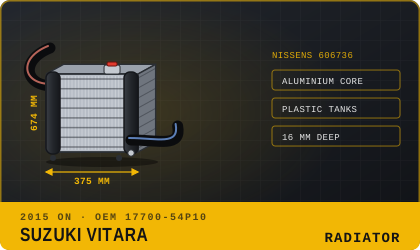 Illustration for editorial purposes
Opens live listings in a new tab.
OEM Part Number: 17700-54P10
As quoted in catalogue listings, confirm via VIN. Aftermarket units: Nissens 606736 / Valeo 701756
| Radiators (aftermarket) | Nissens 606736 (375 x 674 x 16 mm, aluminium core with plastic tanks, fits 1.6 M16A 117/120 PS, 2WD and AllGrip); Valeo 701756; NRF 550031; Van Wezel 52012705; Kamoka 7700254; AKS Dasis 320069N. For the 1.6 DDiS: Nissens 606148 (625 x 404 x 26 mm, aluminium with plastic tanks, also fits the SX4 S-Cross DDiS); Denso DRM47039; NRF 59232 |
|---|---|
| Core sizes & variants | The petrol Vitara has a thin 16 mm radiator with a 674 mm wide core, while the 1.6 DDiS diesel uses a 26 mm core that is narrower and taller. The 1.4 Boosterjet turbo introduced in 2015-16 has its own radiator and is not covered by these two. |
| Genuine (OE) numbers quoted | 17700-54P10 (1.6 petrol); 17700-62M00 (1.6 DDiS) |
| Fitment notes | Both radiators use 34.5 mm connections and are supplied with seals; the petrol unit also comes with a filler cap. |
How the cooling system stops the Vitara overheating
This isn't a part anyone gets excited about, but on the Suzuki Vitara, overlooked cooling problems are responsible for most serious engine failures that aren't simple wear-and-tear. Catching the early symptoms is about the cheapest insurance available against a major bill later.
How the cooling pack works on the Vitara
Keeping the Suzuki Vitara's engine temperature within safe limits comes down to the radiator's job of transferring heat from the coolant into the surrounding air. Automatic-gearbox versions often build in a second circuit for transmission fluid cooling too, which is exactly why fitting the wrong part number can cause two problems, not one.
Watch: replacing itGrand Vitara is a different body-on-frame model, nearest Suzuki only; nothing found on the LY Vitara
Opens live listings in a new tab.
Coolant where it shouldn't be
If you notice coolant coming from the air conditioning system's drain pipe, rather than from underneath the car generally, this is a specific sign pointing toward a leaking heater core rather than the radiator itself — worth checking this detail before assuming the radiator is at fault.
A persistent overheating issue appearing only while driving, rather than at idle, doesn't always mean an external leak — in at least one case, the radiator itself wasn't achieving good coolant flow through its internal passages despite no external leak being visible.
Faults, DIY difficulty and aftermarket adviceThese are the same regardless of make or model — see our full Radiator Guide for the three common failure modes, confirming fitment against your VIN, and OEM vs aftermarket guidance.
The same part on other modelsThe same part, covered across other Suzuki models.