
Suzuki Ignis Rear Shock Absorber: Specs, Fitment & Common Faults
Worth confirming first: drivetrain and left/right side both affect which rear shock fits.
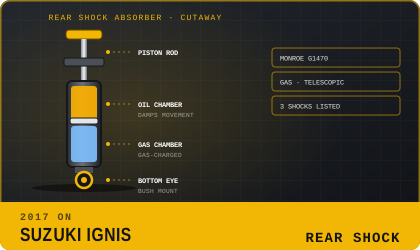 Illustration for editorial purposes
Opens live listings in a new tab.
OEM Part Number: confirm via VIN
Aftermarket rear dampers: Monroe G1470 / Bilstein 19-315591
| Rear shock absorbers (aftermarket) | Monroe G1470 (gas, telescopic); Bilstein 19-315591 (gas); KYB Excel-g 3430083 (gas, telescopic) |
|---|---|
| Genuine (OE) numbers quoted | None quoted in the catalogue listings — the genuine damper varies by engine, suspension type and body style, so order it against your VIN |
| Front-wheel drive, right | a different part number from the left-side shock, and from the AWD version below |
| Front-wheel drive, left | A different reference from the right-side shock above |
| AWD, right/left | different references from the front-wheel-drive shocks, reflecting the different rear axle layout |
On the Suzuki Ignis, replacing just the failed shock absorber and leaving its partner in place risks uneven damping — doing both sides together is the more consistent approach.
Three variables behind the right damper for the Ignis
One detail that trips people up on the Suzuki Ignis: left and right rear shocks have distinct, non-interchangeable part numbers, and AWD variants (where offered) need a different rear shock entirely from front-wheel-drive versions, reflecting their different rear axle design.
How fading dampers change the way the Ignis drives
Because the Suzuki Ignis's front suspension is tied to steering feel, it tends to get all the attention — but rear shocks wear at a similar rate, with symptoms subtle enough to be mistaken for road noise until the problem has clearly worsened.
This is a general walkthrough for the job rather than one for your exact model, so access and fixings can differ on your car.

How the Ignis keeps its back wheels planted
On the Suzuki Ignis, the rear shock absorber's role — separate from the coil spring — is managing how quickly the suspension compresses and rebounds over bumps. When it wears out, the rear end keeps bouncing rather than settling quickly.
Opens live listings in a new tab.
These are the same regardless of make or model — see our full Rear Shock Absorber Guide for symptoms of a worn shock, confirming fitment against your VIN, and OEM vs aftermarket guidance.
The same part on other modelsThe same part, covered across other Suzuki models.