
Suzuki Swift Brake Pads: Specs, Fitment & Wear Symptoms
A Swift Sport's brake squeal survived two full sets of pads and discs, with Suzuki reportedly blaming asbestos-free pad regulations — plus a finding about bent indicator tabs triggering squeals early.
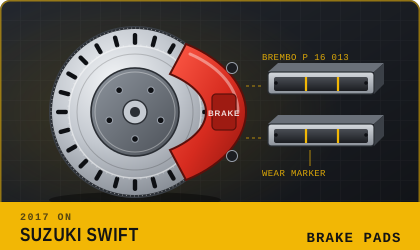 Illustration for editorial purposes
Opens live listings in a new tab.
OEM Part Number: confirm via VIN — front pads (aftermarket) Brembo P 16 013 / Bosch 0 986 494 321
| Front brake pads (aftermarket) | Brembo P 16 013 (126 x 52 x 17 mm, acoustic warning, TRW/Lucas/Girling system, piston clip and anti-squeak plate); Bosch 0 986 494 321 (125.8 x 51.4 x 15.3 mm, acoustic warning, low-metallic); TRW GDB3437 (125.6 x 51.7 x 15.3 mm, acoustic warning); ATE 13.0460-5794.2 (125.4 x 51.4 x 15.5 mm, acoustic warning, caliper screws included); Ferodo FDB4426 (125.7 x 52.1 x 16 mm, acoustic warning); Textar 2428303 (125.6 x 51.7 x 16.1 mm, acoustic warning); Delphi LP3364 (125.9 x 51.4 x 15.3 mm, acoustic warning). |
|---|---|
| Pad sizes & variants | One front size of about 126 x 52 mm, in thicknesses from 15.3 to 17.6 mm (Ridex 402B0129 is 17.6 mm). Ferodo also lists a track-day racing compound, FCP4426H. |
| Genuine (OE) numbers quoted | None quoted in catalogue listings — order genuine pads against your VIN |
| Fitment notes | All front sets include a built-in acoustic wear warning, so no separate sensor is needed. The system is TRW/Lucas/Girling. |
Being one of the lighter cars in its class doesn't mean the brakes matter any less — if anything, the Swift's low weight means owners often push it harder through corners and town driving, which can affect pad wear just as much as a heavier car driven gently.
How the Swift turns pedal pressure into stopping power
Brake pads clamp against the discs to convert the car's momentum into heat, slowing it down. The mild-hybrid system on the Swift provides a small amount of regenerative assistance, though the effect on pad wear is modest compared with a full hybrid or electric car.
Watch: replacing them2017 onwards Swift.

What decides the pad size on Suzuki's Swift
| Standard front-wheel-drive (front) | Standard size — confirm via VIN |
|---|---|
| Allgrip four-wheel-drive | Confirm compatibility given the different drivetrain layout |
Opens live listings in a new tab.
The Swift Sport screech that fresh pads didn't cure
If your Swift Sport has a persistent squeal or screech under braking that doesn't go away even after fresh pads, one case saw exactly this on an 08-plate car, with the noise persisting through two full sets of pads and discs replaced all round, plus a further set of front pads on top of that — suggesting this is a persistent characteristic of this specific car rather than simply a wear issue that fresh parts alone resolve. In that case, Suzuki reportedly attributed the noise to newer pad regulations around asbestos-free friction material formulations, though it's worth knowing this explanation didn't necessarily satisfy the owner or fully resolve the noise either.
A chirping noise that stops once the brake pedal is actually pressed often points toward a thin rust lip that's formed around the edge of the disc rather than the pads themselves — vigorous braking a few times can sometimes clean this off on its own. If a squeal survives a proper pad replacement, a specific anti-vibration product applied to the back of the pad, rather than the pad material itself, is designed to dampen the vibration causing the noise rather than addressing genuine wear.
Wear symptoms, DIY difficulty and aftermarket adviceThese are the same regardless of make or model — see our full Brake Pads Guide for warning signs to watch for, confirming fitment against your VIN, and R90-certified aftermarket brands worth trusting.
The same part on other modelsThe same part, covered across other Suzuki models.