
Toyota Auris Brake Discs: Specs, Fitment & Wear Symptoms
On the Auris, a useful myth worth correcting: discs don't actually "warp" — plus a counterintuitive hybrid fact.
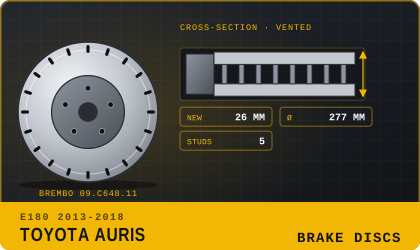 Illustration for editorial purposes
Opens live listings in a new tab.
OEM Part Number: confirm via VIN
Aftermarket front discs: Brembo 09.C648.11 / Bosch 0 986 479 A62
| Front brake discs (aftermarket) | Brembo 09.C648.11 (277 x 26 mm, vented, 5 holes, coated, min 23 mm); Bosch 0 986 479 A62 (277 x 26 mm, vented, 5 holes, coated, min 23 mm, ECE-R90); ATE 24.0126-0184.1 (277 x 26 mm, vented, 5 holes, coated, min 23 mm); Brembo 09.B043.11 (295 x 26 mm, vented, 5 holes, coated, min 23 mm); ATE 24.0126-0156.1 (295 x 26 mm, vented, 5 holes, coated, min 23 mm); Brembo 09.A417.11 (296 x 28 mm, vented, 5 holes, coated, min 25 mm); Bosch 0 986 479 768 (296 x 28 mm, vented, 5 holes, oiled, high-carbon, min 25 mm); ATE 24.0128-0159.1 (296 x 28 mm, vented, 5 holes, coated, min 25 mm). |
|---|---|
| Disc sizes & variants | four front sizes are listed, 273 x 26 mm (Ridex 82B0365 only), 275 x 22 mm (Ridex 82B0863 only), 277 x 26 mm, 295 x 26 mm and 296 x 28 mm. The 277 x 26 mm disc is the small-engine fitment and the 295-296 mm discs are the larger-brake fitment for the higher-output petrol, hybrid and diesel versions |
| Genuine (OE) numbers quoted | None quoted in catalogue listings — order genuine discs against your VIN |
| Fitment notes | Minimum thickness 23 mm for the 26 mm discs and 25 mm for the 28 mm discs. All are 5-stud. TRW DF4939S and DF4828S are also listed but without a stated fitting position. |
What experienced owners say about judder on the Auris
If you're feeling a pulsing sensation through the brake pedal and have been told the discs have "warped," this is worth understanding: discs don't actually physically warp or bend. What's happening is that pad material transfers unevenly onto the disc surface, creating slightly higher and lower points around the circumference — this is what you feel as pulsing. A common cause worth knowing: holding the brake pedal down while stationary immediately after hard braking, rather than releasing it once stopped, keeps heat concentrated in one spot and encourages exactly this kind of uneven deposit.
Also, a car left standing overnight with heavily corroded discs can occasionally feel stuck when trying to pull away — a firm, deliberate application of the accelerator followed by a couple of firm brake applications once moving typically clears this within a few hundred metres.
Why pads are only as good as the rotors behind them
On the Toyota Auris, discs and pads don't wear independently — neglect one and the other degrades faster too, which is exactly why what starts as a routine pad change frequently turns into a disc replacement as well.
Watch: replacing themGerman; E18 = E180 generation. English videos found are E150 (older gen) e.g. 0oMhPzRTiHk.

Vented, solid and drilled: what the Auris uses and why
Brake discs provide the surface the brake pads clamp against to slow the car, converting momentum into heat through friction. Larger, sportier trims of the Auris typically use bigger discs than standard versions to handle the additional heat generated by more aggressive braking.
Opens live listings in a new tab.
These are the same regardless of make or model — see our full Brake Discs Guide for warning signs to watch for, confirming fitment against your VIN, and choosing a reliable aftermarket disc.
The same part on other modelsThe same part, covered across other Toyota models.