
Toyota Aygo Battery: Specs, Fitment & Common Faults
On the Aygo, a battery that keeps going flat despite testing healthy points toward a parasitic drain, not necessarily the battery itself.
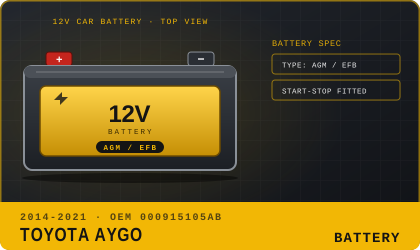 Illustration for editorial purposes
Opens live listings in a new tab.
OEM Part Number: 000915105AB
| Mk1 (2005-2014), standard fitment (shared with C1, 107) | 175-207mm case, no Start/Stop on the simplest versions, so no AGM/EFB requirement |
|---|---|
| Genuine cross-reference numbers | 000915105AB, 000915105DB, 000915105DC, 000915105DP |
| Mk2 (2014 onwards), Start/Stop variants | EFB technology required — confirm your exact trim before ordering |
Symptom or root cause: a flat Aygo
A flat battery on a conventional petrol or diesel Toyota is often a symptom rather than the root cause — a battery that keeps going flat despite being tested as healthy points toward a parasitic drain somewhere in the electrical system, rather than the battery itself being at fault. Before replacing the battery on a hunch, it's worth having a proper drain test done, since replacing a battery that wasn't actually the problem just delays finding the real cause.
Note too that modern cars, including older conventional Toyota models, carry more permanently-live electrical draw than owners often expect — alarm systems, clock memory, and various modules all draw a small amount of current even with the ignition off, meaning a battery in marginal health can go flat from ordinary standing that wouldn't have affected a healthier battery.
Slow cranking on the Aygo: where the fault sits
On the Toyota Aygo, the battery takes the blame for most no-start situations, and often rightly so — it's a sensible first check. But it isn't always the cause, which is worth establishing before paying for a new one that turns out not to solve anything.
Watch: replacing itFilmed on a first-generation Aygo.
Stop-start, electronics and cranking: the load on the Aygo
The Toyota Aygo's 12V battery handles engine starts and keeps electrical systems running whenever the engine isn't. On stop-start versions, that job gets much harder, since the engine switches off and restarts constantly — which is why it needs an AGM or EFB battery, not a standard one.
Opens live listings in a new tab.
These are the same regardless of make or model — see our full Battery Guide for warning signs to watch for, confirming fitment against your VIN, and matching the right technology (standard, EFB, AGM) when buying aftermarket.
The same part on other modelsThe same part, covered across other Toyota models.