
Toyota Corolla Battery: Specs, Fitment & Common Faults
Toyota's own dealer test may not let the battery stabilise before checking it, masking a problem — plus official Ready-mode guidance worth following.
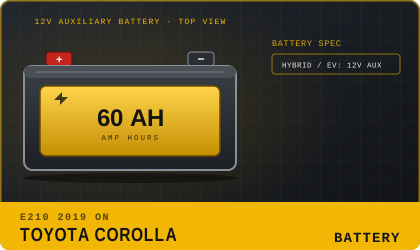 Illustration for editorial purposes
Opens live listings in a new tab.
OEM Part Numbers & Sizes
| 12V battery, 2019–2022 Hybrid (LN2, 60Ah) | Toyota OEM: 28800-AZC02 |
|---|---|
| Cross-reference (shared with several other Toyota hybrids) | Toyota OEM: 28800-YZZUF |
| BCI group / type, 2020–2023 Hybrid | LN1-MF |
| Location | Under the bonnet, right-hand side, behind the headlight |
A healthy 12V battery should read 12.6–12.8 volts when tested. If your Corolla Hybrid won't power on, struggles to "ready" the hybrid system, or the 12V battery keeps draining, it's this small battery that's almost always the cause — not the large hybrid drive battery, which Toyota separately warranties for 36 months regardless of mileage when installed by an authorised dealer.
Passed all checks, still low: the hybrid Corolla
If your Corolla Hybrid's 12V battery keeps reading low despite a dealer telling you it "passed all checks," this is useful to know: real owner reports, supported by third-party analysis, suggest Toyota's own dealer diagnostic test doesn't allow the battery sufficient time to stabilise after charging before testing it — meaning a weak battery can pass the test, only for the voltage to drop again within hours once it's had time to settle. This can create a maddening, real cycle of paying for a charge or check, being told it's fine, and having the same problem return days later. It's worth understanding why hybrids are more prone to this at all: since the hybrid powertrain doesn't use the 12V battery for traditional engine cranking the way a conventional car does, manufacturers fit a considerably smaller-capacity battery (commonly around 45Ah) — adequate for its actual job, but with less margin to absorb the effects of short journeys or extended standing.
If the problem is persistent despite following this guidance, it's worth pushing for a proper cell-level health check rather than accepting a simple charge-and-return: one case saw Toyota's own diagnostics find damaged cells within the battery, resolved with a warranty replacement using a higher-capacity unit — after which the problem stopped entirely. If you're facing repeat failures, it's worth asking whether this deeper check has been done, rather than accepting repeated charges as the ongoing solution.
Symptom or cause: reading a non-start on the Corolla
A Toyota Corolla that won't start gets blamed on the battery more often than any other component, and it's right often enough to make that assumption a reasonable first check. But it's not always the actual cause, so check this before spending money on a replacement that doesn't fix anything.
Filmed on a US-market Corolla of the Auris era; the hybrid E210 has its 12V battery in the boot.
How the Corolla stores and supplies electrical power
The Toyota Corolla's 12V battery provides the power needed to start the engine and runs electrical systems when the engine isn't turning. On cars with stop-start technology, the battery works much harder than on older designs, since the engine switches off and restarts far more frequently — which is exactly why these cars need a specific AGM or EFB battery type rather than a standard unit.
Opens live listings in a new tab.
These are the same regardless of make or model — see our full Battery Guide for warning signs to watch for, confirming fitment against your VIN, and matching the right technology (standard, EFB, AGM) when buying aftermarket.
The same part on other modelsThe same part, covered across other Toyota models.