
Toyota GT86 Radiator: Specs, Fitment & Common Faults
On the GT86, a useful diagnostic pattern: coolant loss at higher speeds points toward a pressure or cap issue.
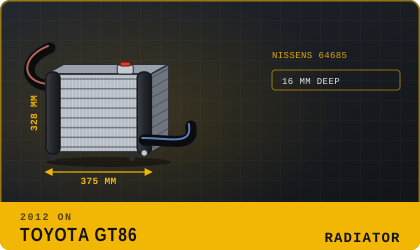 Illustration for editorial purposes
Opens live listings in a new tab.
OEM Part Number: confirm via VIN
Aftermarket units: Nissens 64685 / Valeo 735072
| Radiators (aftermarket) | Nissens 64685 (375 x 328 x 16 mm, without cap, without expansion tank, with gaskets/seals); Valeo 735072 (375 x 328 x 16 mm, for vehicles without oil cooler, without coolant regulator); Denso DRM21602 (350 x 374 x 16 mm) |
|---|---|
| Core sizes & variants | One 375 x 328 x 16 mm core for the 2.0 boxer; the GT86 is a Subaru-built car and shares the part with the BRZ. |
| Genuine (OE) numbers quoted | None quoted in catalogue listings — order a genuine unit against your VIN |
| Fitment notes | Subaru BRZ-catalogued radiators are the same part; the automatic versions carry an in-tank oil cooler. |
Overflow loss at motorway speed on the GT86
If you're losing coolant through the overflow or header tank pipe, and it seems to happen only at higher speeds, this specific pattern points toward excessive pressure building up in the cooling system, rather than a head gasket issue, particularly if a proper block test has already ruled the head gasket out. A radiator cap that's no longer holding pressure correctly, or a partial blockage somewhere in the system, are both worth checking.
Also, coolant leaking from the water pump's shaft seal, visible as a small weep beneath the pump, is often one of the earliest signs of pump failure.
Why coolant matters more than most owners think
There's nothing exciting about this component, yet on the Toyota GT86, most catastrophic engine failures that aren't simply down to wear trace back to a cooling problem someone ignored too long. Catching it early is cheap; catching it late usually isn't.
Watch: replacing itSame car as GT86; aftermarket rad but stock removal shown.
Coolant flow through the GT86's engine
The Toyota GT86 radiator's core job is moving heat out of the engine coolant and into the passing air, holding engine temperature within safe limits. Automatic versions frequently add a second internal circuit for transmission fluid cooling, which is exactly why the correct part number carries extra weight on this component.
Opens live listings in a new tab.
These are the same regardless of make or model — see our full Radiator Guide for the three common failure modes, confirming fitment against your VIN, and OEM vs aftermarket guidance.
The same part on other modelsThe same part, covered across other Toyota models.