
Vauxhall Astra Fuel Pump: Specs, Fitment & Common Faults
Diesel Astras use two separate fuel pumps working together — plus a specific, well-documented electronics fault on older diesel models that's often cheaper to repair than replace.
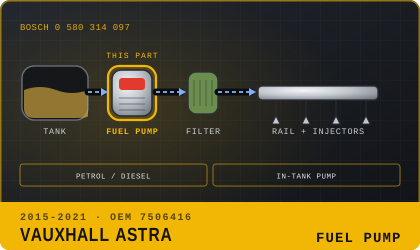 Illustration for editorial purposes
Opens live listings in a new tab.
OEM Part Number: 7506416
As quoted in catalogue listings, confirm via VIN. Aftermarket units: Bosch 0 580 314 097 / Pierburg 7.21440.51.0
| Fuel pumps / feed units (aftermarket) | Bosch 0 580 314 097 (bare in-tank pump, with mounting material and connector parts); Delphi FE0438-12B1 (bare in-tank pump, petrol, metal, 128 mm, without pressure sensor); Delphi FE0429-12B1 (bare in-tank pump, petrol, metal, 113 mm); Delphi FE0448-12B1 (in-tank pump, petrol, metal, 179 mm); Pierburg 7.21440.51.0 (low-pressure pump, 0.3 to 0.4 bar, 2-pin, 2 A); ERA 770048A (bare in-tank pump, 3 bar / 90 l/h, 2-pin); Ridex 458F0081 (bare in-tank pump, 3 bar / 90 l/h, 2-pin, 208 mm); Laser Tools 7998 (pump tool, OE EN-50885, not a pump). |
|---|---|
| Types & variants | All listings are bare electric pumps or pump modules; no complete feed unit with a level sender is offered for the Astra K. The 1.0, 1.2 and 1.4 turbo petrols use an in-tank pump of around 3 to 4 bar |
| Genuine (OE) numbers quoted | Laser Tools 7998 quotes EN-50885; Meat & Doria 76416 and Hoffer 7506416 quote 170429F500; Kamoka 8410005 quotes 8450008680; Meat & Doria 76041 quotes 8941674933 (carburettor pump, not relevant). |
| Fitment notes | Petrol in-tank pumps on the Astra K can be swapped into the original housing while the sender and float stay in place, which keeps the fuel gauge calibration; the tank is accessed under the rear seat. Diesel owners need the complete sender module, which is not listed here. |
Diesel Astras use two separate pumps
If your Astra is diesel-engined, there are two separate fuel pumps working together, not one: a low-pressure "lift" pump inside the tank, and a high-pressure pump mounted on the engine and driven by the timing belt or camshaft. A fault can originate in either one, and correctly identifying which is at fault matters — a whining noise when the ignition is turned to "on" (before starting) confirms the in-tank lift pump is at least attempting to prime the system; silence here points to the lift pump, its fuse, or its relay as the likely cause, while a car that primes normally but still struggles to start or runs rough under load points more toward the engine-mounted high-pressure pump instead.
The early signs of a tired pump on the Astra
On the Vauxhall Astra, there's rarely a convenient time for this to fail — it tends to strike mid-journey rather than while the car's sitting safely on the drive. Knowing what the early symptoms look like buys valuable time to get ahead of it.
Romanian narration; English dealer video nzFYN0kEFnQ does not state generation
The job here is simple in principle — draw fuel from the tank, deliver it to the engine at the right pressure — but the Vauxhall Astra's fuel pump sits submerged inside the tank, which makes physical access for replacement far more involved than the small part itself implies.
How pump design differs across Astra engines
| Astra H (2004–2009), 1.6/1.8 petrol | Petrol: typically a single in-tank low-pressure pump; some later or higher-output variants may add a separate engine-mounted high-pressure pump for direct injection — confirm your exact engine |
|---|---|
| Astra H (2004–2009), 1.7/1.9 CDTi diesel | Diesel: in-tank lift pump feeds a separate engine-mounted high-pressure injection pump (common rail) — never interchangeable with the petrol pump |
| Astra H VXR (2005–2010), 2.0 turbo (Z20LEH) | Petrol: typically a single in-tank low-pressure pump; some later or higher-output variants may add a separate engine-mounted high-pressure pump for direct injection — confirm your exact engine |
| Astra J (2009–2015), 1.4 Turbo & 1.6 SIDI Turbo | Petrol (direct injection): in-tank low-pressure pump plus a separate engine-mounted high-pressure pump |
| Astra J (2009–2015), 1.6 CDTi "whisper diesel" | Diesel: in-tank lift pump feeds a separate engine-mounted high-pressure injection pump (common rail) — never interchangeable with the petrol pump |
| Astra J VXR/GTC VXR (2012–2018), 2.0 turbo (B20NFT) | Petrol: typically a single in-tank low-pressure pump; some later or higher-output variants may add a separate engine-mounted high-pressure pump for direct injection — confirm your exact engine |
| Astra K (2015–2019), 1.4 Turbo & 1.6 CDTi | Spans both diesel (in-tank lift pump plus an engine-mounted high-pressure pump) and petrol (in-tank low-pressure pump, plus a separate high-pressure pump if direct-injection) variants — confirm your exact engine before ordering |
| Astra K facelift (2019–2021), 1.2 turbo | Petrol: typically a single in-tank low-pressure pump; some later or higher-output variants may add a separate engine-mounted high-pressure pump for direct injection — confirm your exact engine |
| Astra K GSi (2018–2021), 2.0 turbo (A20NHT) | Petrol: typically a single in-tank low-pressure pump; some later or higher-output variants may add a separate engine-mounted high-pressure pump for direct injection — confirm your exact engine |
| Astra L (2021–present), 1.2 PureTech petrol | Petrol (direct injection): in-tank low-pressure pump plus a separate engine-mounted high-pressure pump |
Opens live listings in a new tab.
These are the same regardless of make or model — see our full Fuel Pump Guide for symptoms to watch for (including the low-pressure vs high-pressure distinction on direct-injection engines), confirming fitment against your VIN, and OE suppliers worth knowing.
The same part on other modelsThe same part, covered across other Vauxhall models.