
Volkswagen Caddy Rear Shock Absorber: Specs, Fitment & Common Faults
Worth confirming first: which rear axle your Caddy has, since it determines a completely different shock absorber.
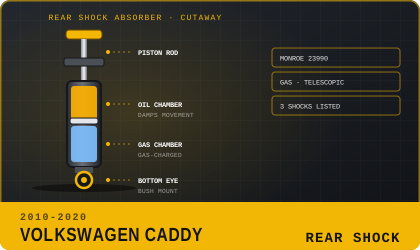 Illustration for editorial purposes
Opens live listings in a new tab.
OEM Part Number: confirm via VIN
Aftermarket rear dampers: Monroe 23990 / Febi Bilstein 194218
| Rear shock absorbers (aftermarket) | Monroe 23990 (gas, telescopic); Febi Bilstein 194218 (gas, telescopic); Febi Bilstein 1002449 (gas, telescopic, to 08/2016) |
|---|---|
| Genuine (OE) numbers quoted | None quoted in the catalogue listings — the genuine damper varies by engine, suspension type and body style, so order it against your VIN |
| Torsion beam axle, right | a different reference from the left-side shock — VW Group does not sell these as a single interchangeable part for either side |
| Torsion beam axle, left | A different part number from the right-side shock above |
| Multi-link axle (higher-output/4Motion variants) | a different shock from the torsion beam version — confirmed by VW Group's own workshop documentation as requiring a completely different rear damper, not a stiffer version of the same part |
| Adaptive damping shock, where fitted | A different construction from a non-adaptive shock, with a built-in electrical connector — not interchangeable with a standard shock in either direction, and fitting the wrong type will trigger a persistent dashboard warning |
On the Volkswagen Caddy, cars fitted with a vehicle level sender (part of some self-levelling or headlight self-levelling setups) have an additional linkage arm connected near the shock absorber — worth noting when removing or replacing the shock, since this arm needs to be disconnected first, but it's a separate part from the shock itself.
The axle split that catches out Caddy buyers
Important to establish before ordering: VW Group's MQB-based cars use one of two different rear axle designs depending on engine and trim, and each requires a different rear shock absorber. Standard Caddys with smaller petrol or diesel engines use a torsion beam (twist beam) rear axle. Higher-output and performance variants use a multi-link rear axle instead — and critically, any 4Motion/4Drive/Quattro (four-wheel-drive) variant mandatorily has multi-link regardless of engine, since a torsion beam leaves no room for a rear differential and driveshaft to pass through. If you're unsure which your car has, look underneath the rear of the car: a single, solid connecting beam is torsion beam; separate arms at each wheel is multi-link.
How fading dampers change the way the Caddy drives
On the Volkswagen Caddy, most attention (and most complaints) go to the front suspension because of its role in steering, yet the rear shocks wear on a similar timeline — just more quietly, easy to write off as road noise until it's obviously gotten worse.

How the dampers stop the Caddy bouncing
Working independently of the coil spring on most current rear axles, the Volkswagen Caddy's rear shock absorber determines how quickly the suspension settles after a bump. A worn unit lets the back of the car bounce for longer than it should, which can accelerate uneven rear tyre wear if it's not sorted.
Opens live listings in a new tab.
These are the same regardless of make or model — see our full Rear Shock Absorber Guide for symptoms of a worn shock, confirming fitment against your VIN, and OEM vs aftermarket guidance.
The same part on other modelsThe same part, covered across other Volkswagen models.