
Volkswagen Polo Timing Belt: Intervals, Fitment & Warning Signs
Confirmed: the Polo's EA211 petrol engines use a belt, not a chain — plus a specialist's nuanced advice on trusting VW's newly extended interval.
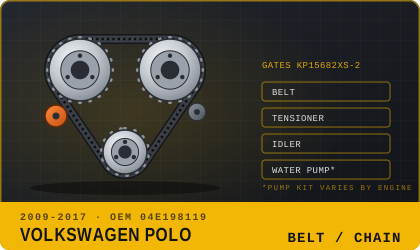 Illustration for editorial purposes
Opens live listings in a new tab.
OEM Part Number: 04E198119
| Mk5 (2010–late 2011), 1.2 TSI (EA111) | Timing chain — chain kit OE references 03F109158K / 03F109469C / 03F109509C / 03F109571C, single source, confirm via VIN |
|---|---|
| Mk5 (2010–2014), 1.4 TSI and 1.4 GTI | Timing chain — no belt kit required |
| Mk5 / Mk6 (2014–present), 1.0 MPI and 1.0 TSI (EA211) | Genuine VW: 04E198119 family, suffix confirm via VIN. Aftermarket: Gates KP15682XS-2 (with water pump), Contitech CT1185WP2, INA 530 0744 30 |
| Mk5 / Mk6 (2014–present), 1.2 TSI (EA211) | Genuine VW: 04E198119 family, suffix confirm via VIN. Aftermarket: Vemo belt and water pump kit, Dayco KTB819 belt |
| Mk5 (2010–2014), 1.2 TDI | Genuine VW: 03L198119 family (A / C / F suffixes quoted, confirm via VIN). Aftermarket: Febi timing kit, Gates K025649XS, Contitech CT1139K2 |
| Mk5 (2010–2014), 1.6 TDI | Genuine VW: 03L198119 family, confirm via VIN. Aftermarket: Gates K025649XS / KP25649XS-1 (with pump), Contitech CT1139K2, INA 530 0550 10 |
| Mk5 / Mk6 (2014–present), 1.4 TDI | Genuine VW: 04L198119 family, confirm via VIN. Aftermarket: Gates KP25678XS (with pump), Contitech CT1168WP2, INA 530 0665 30, Dayco KTBWP9990 |
Which Polo engines use a belt
Engines in the Polo range, split by cam drive
| 9N/9N3 (2002–2009), 1.2/1.4 petrol | Timing belt — conventional dry belt |
|---|---|
| 9N3 GTI (2006–2008), 1.8T petrol | Timing belt for the cams, small chain between the cams — hybrid design, belt still needs scheduled replacement |
| 6R (2009–2014), 1.2 TSI petrol (EA111, CBZC/CBZB) | Timing chain — documented stretch issue from around 120,000–150,000km if oil changes lapse |
| 6R GTI (2010–2014), 1.4 TSI twincharged (CAVE) | Timing chain — same EA111 lineage as the standard 1.2 TSI |
| 6C facelift (2014–2017), 1.2 TSI petrol | Timing belt — VW deliberately moved back to a belt after the 6R's chain reliability issues, officially rated as a "lifetime" component |
| AW/BZ (2017–present), 1.0/1.5 TSI petrol (EA211/EA211evo) | Timing belt — see confirmation above |
| AW/BZ GTI (2018–present), 2.0 TSI (EA888) | Timing chain — consistent with the Golf GTI's EA888 chain design |
The unusual part of this story: VW moved the Polo from a chain back to a belt between the 6R and 6C — the opposite of the industry's general shift away from belts — because the 6R's chain proved less durable than expected. If you're comparing a 6R against a 6C and assuming the newer car's chain is automatically the safer bet; in this case, it wasn't.
The cost of leaving the Polo too late
Skipping this one on the Volkswagen Polo carries more downside risk than almost any other maintenance item on the car. On engines where it fails, the damage typically spreads well beyond the part itself, which is exactly why the replacement schedule matters more here than almost anywhere else.

On the Volkswagen Polo, precise synchronisation between the camshafts and crankshaft is what the timing belt or chain provides, making sure valves open and close at exactly the right point relative to piston position. Many engines use what's called an "interference" design, where a belt failure lets pistons and valves collide, causing serious internal damage.
Opens live listings in a new tab.
This covers the smaller VAG diesel engine family. Petrol TSI engines are chain-driven and don't need this procedure — check which your car has above.
Warning signs, DIY difficulty and aftermarket adviceThese are the same regardless of make or model — see our full Timing Belt Guide for symptoms to watch for, confirming fitment against your VIN, and which aftermarket brands are worth trusting.
The same part on other modelsThe same part, covered across other Volkswagen models.