
BMW 1 Series Rear Springs: Specs, Fitment & Common Faults
Confirmed by suspension specialists: the rear springs come off without a spring compressor, but matching the right spring to your suspension type matters more than it might seem.
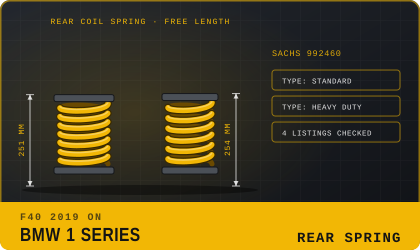 Illustration for editorial purposes
Opens live listings in a new tab.
OEM Part Number: confirm via VIN
Aftermarket coils: Sachs 992460 / Suplex 06616
| Rear coil springs (aftermarket) | Sachs 992460 (heavy duty, 251 mm); Sachs 992456 (standard, 254 mm); Suplex 06616 (heavy duty, 251 mm); Suplex 06612 (standard, 254 mm) |
|---|---|
| Genuine (OE) numbers quoted | None quoted in the catalogue listings — the genuine spring varies by engine, suspension type and body style, so order it against your VIN |
| Standard suspension, RWD | a different spring from the xDrive version below, and from the M Sport spring further down — confirm drivetrain and suspension type before ordering |
| Standard suspension, xDrive | A different spring from the RWD version above, reflecting the different rear axle layout needed for the AWD driveline |
| M Sport spring (passive or Adaptive M) | A different, stiffer spring from Standard — shared between passive M Sport and Adaptive M suspension, since the electronic system adjusts damping rather than spring rate |
| Self-levelling (pneumatic/air spring), where fitted | A different type of spring entirely from a conventional coil — confirmed by BMW's own parts terminology as a distinct "pneumatic spring" rather than a steel coil |
Always replace BMW 1 Series rear springs in pairs — a single new spring paired with an old, sagged one on the other side creates an uneven ride height and handling bias.
Easy mistakes when ordering coils for the 1 Series
Unlike the front strut, the rear spring on this platform is a separate component from the shock absorber and doesn't need a spring compressor to remove or install — a more DIY-friendly job than the front. That said, spring rates and lengths vary significantly based on suspension type (Standard, M Sport, Adaptive M) and drivetrain (RWD vs xDrive), so it's worth matching the part number from your original spring or verifying against your VIN rather than assuming from trim badge alone.
Why coil springs at the back of the 1 Series fail without warning
The most common sign of a failing rear spring is uneven ride height or gradual sagging — one corner of the car sitting visibly lower than the other, or the entire rear end looking lower than normal, well before any dramatic failure.
This video is of an earlier generation of the same model; the job is similar but the spring seats and fixings can differ slightly.

What the coils do and what the dampers do
The BMW 1 Series's rear coil spring supports the weight of the car's rear end and absorbs the initial impact of a bump, working alongside the shock absorber (which controls the spring's rate of compression and rebound) rather than replacing its function. A sagged or broken spring lowers ride height, can affect headlight aim, and in severe cases is an MOT failure item.
Opens live listings in a new tab.
These are the same regardless of make or model — see our full Rear Springs Guide for symptoms of a failing spring, confirming fitment against your VIN, and OEM vs aftermarket guidance.
The same part on other modelsThe same part, covered across other BMW models.