
Ford Puma Cabin Air Filter: Intervals, Fitment & Warning Signs
A real disinfectant trick clears a musty smell from the ductwork itself — worth doing alongside a fresh filter, not instead of one.
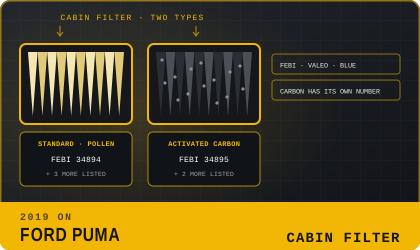 Illustration for editorial purposes
Opens live listings in a new tab.
OEM Part Number: confirm via VIN
Aftermarket pollen filters: Febi 34894 / Valeo 715660
| Cabin filter, standard (aftermarket) | Febi 34894, Valeo 715660, Blue Print ADM52518, Filtron K1251 |
|---|---|
| Activated-carbon version (aftermarket) | Febi 34895, Blue Print ADF122505, Filtron K 1251A |
| Genuine (OE) number | Not quoted in the catalogue listings — the fitted filter varies by trim and build date, so order the genuine one against your VIN |
| Fitment notes | Standard and carbon filters have different numbers, and the right size depends on trim and build date. Check which type your car was built with before ordering. |
The step after fitting a fresh filter to the Puma
If you're changing the filter because of a musty smell, it's worth going one step further: after fitting the new filter, spray a can of disinfectant (a household product like Dettol works well) into the intake vents, then run the fans on full with heat at maximum in recirculation mode for several minutes with windows and doors closed. This helps sterilise mould and mildew that can build up through the entire duct network and heater box, not just the filter itself — simply replacing the filter alone doesn't always fully resolve a persistent musty smell if the ductwork itself has mildew growth. Leaving the air conditioning running periodically rather than switching it off entirely also helps keep the system dry and less prone to this in the first place.
Why the Puma's pollen filter slips off the service list
On the Ford Puma, this part sits in an unusual category: neglecting it changes nothing about how the car drives, so there's no natural prompt to replace it. It only affects the air you're breathing inside the cabin, which is why it's so often left well past its interval.
How the Puma cleans the air coming through the vents
Every bit of air blown through the Ford Puma's cabin vents passes through this filter first, which is what traps dust and pollen — plus some odours and pollutants if it's an activated-carbon type. It has nothing to do with the engine air filter, a wholly separate component built for the combustion side of things.
Opens live listings in a new tab.
These are the same regardless of make or model — see our full Cabin Air Filter Guide for signs it needs changing, confirming fitment against your VIN, and choosing standard, carbon, or HEPA media.
The same part on other modelsThe same part, covered across other Ford models.