
Hyundai i20 Exhaust System: Specs, Fitment & Common Faults
On the i20, if diesel, a dealer on a related model dismissed visible soot and exhaust staining three separate times as "within acceptable limits."
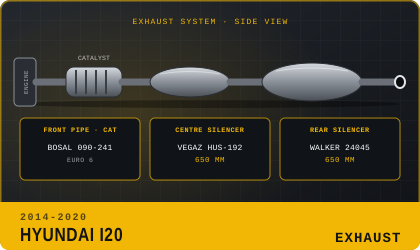 Illustration for editorial purposes
Opens live listings in a new tab.
OEM Part Number: confirm via VIN
Aftermarket rear silencers: Bosal 165-037 / Walker 24045
| Rear silencer (back box) — aftermarket | Walker 24045 (650 mm, code 52); Bosal 165-037; Ernst 646123; MTS 01.61241 (610 mm); MTS 01.60563 (800 mm); Vegaz HUS-256 |
|---|---|
| Centre / intermediate silencer — aftermarket | Vegaz HUS-192 (650 mm); Polmo 10.13; Izawit 32.007 (2002-2006 years, mismatch) |
| Front pipe / catalytic converter (DPF on diesels) — aftermarket | Bosal 090-241 (Euro 6); Walker 28926 (340 mm, code 91); Vegaz HUK-952 (Euro 6); BM Catalysts BM92478H (with FK92478); JMJ 1091678 (engine G4LA) |
| Genuine (OE) numbers quoted | None quoted in catalogue listings — order genuine parts against your VIN |
| Fitment notes | Engines 1.0 T-GDI, 1.2, 1.4, CRDi at category level. |
Pushing back on a dismissive exhaust diagnosis
If you're facing a dismissive response to visible evidence of a genuine exhaust or DPF issue, one case on a related diesel Hyundai model saw a visibly sooty boot and black-stained exhaust pipes dismissed by the dealer three separate times, each time being told no faults were recorded and the car was within acceptable limits. If you're seeing clear physical evidence of an issue despite a diagnostic scan showing no fault codes, it's worth pushing back and requesting a more thorough physical inspection.
Bear in mind that hesitation occurring when the engine is warm rather than cold, at a fairly consistent RPM, with the problem easing when the air conditioning is switched on, has been linked to EGR-related issues on related diesel models.
Noise, smell and smoke from the back of the i20
On the Hyundai i20, sound is usually the first clue here, ahead of any visual sign — a rattle, a drone, noise that's crept in gradually or arrived overnight. It's one of the more forgiving faults in that sense, since your ears will likely flag it before it becomes a bigger problem.
Watch: replacing itRear muffler video; generation not stated in title
What the exhaust does on the i20 beyond carrying gas away
The Hyundai i20's exhaust system handles three things at once: clearing burnt gases from the engine, cutting noise via the silencer, and treating emissions through a catalytic converter and particulate filter. Because petrol and diesel emissions requirements differ, it often uses different exhaust systems depending on engine type.
Opens live listings in a new tab.
These are the same regardless of make or model — see our full Exhaust System Guide for warning signs and fault codes to watch for, confirming fitment against your VIN, and which aftermarket brands are worth trusting.
The same part on other modelsThe same part, covered across other Hyundai models.