
Hyundai Kona Exhaust System: Specs, Fitment & Common Faults
On the Kona, if diesel, a dealer on a related model dismissed visible soot and exhaust staining three separate times as "within acceptable limits."
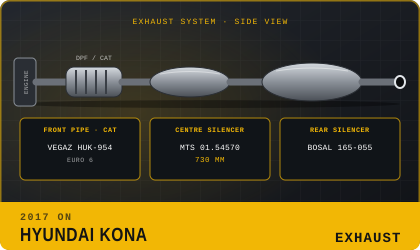 Illustration for editorial purposes
Opens live listings in a new tab.
OEM Part Number: confirm via VIN
Aftermarket rear silencers: Bosal 165-055 / Walker 24045
| Rear silencer (back box) — aftermarket | Bosal 165-055, 165-285, 165-023, 165-037, 165-287 (all need accessories/fitting parts); Walker 24045 (650 mm, without attachment parts); Ernst 646048; MTS 01.61241 (610 mm), 01.61081 (520 mm), 01.60563 (800 mm), 01.60381 (640 mm); Vegaz HUS-243, HUS-256, HUR-128; Polmo 10.41, 10.63, 10.15; Izawit 32.030, 32.011, 32.026, 32.005 |
|---|---|
| Centre / intermediate silencer — aftermarket | MTS 01.54570 (730 mm); Vegaz HUS-192 (650 mm); Polmo 10.13; No Bosal/Walker listed. |
| Front pipe / catalytic converter (DPF on diesels) — aftermarket | or DPF: Vegaz HUK-954 (up to Euro 6), HUK-952QP (Euro 6, front), HUK-360 (Euro 6); BM Catalysts BM92897H (Euro 6, only with FK92897), BM92005H (Euro 5, FK92005); JMJ 1091678 (engine G4LA), 1091690 (G3LA, 4.5 kg), 1091580 (460 mm); AS 25152 / 61083 (Euro 6, 350 mm, OBD); NAP CAK11601 (Euro 6, 350 mm). |
| Genuine (OE) numbers quoted | None quoted in catalogue listings — order genuine parts against your VIN |
| Fitment notes | individual products give no engine split. MTS numbers are followed by trim/equipment codes, not OE numbers. |
An account of exhaust trouble on the Kona
If you're facing a dismissive response to visible evidence of a genuine exhaust or DPF issue, one case on a related diesel Hyundai model saw a visibly sooty boot and black-stained exhaust pipes dismissed by the dealer three separate times, each time being told no faults were recorded and the car was within acceptable limits. If you're seeing clear physical evidence of an issue despite a diagnostic scan showing no fault codes, it's worth pushing back and requesting a more thorough physical inspection.
Also, hesitation occurring when the engine is warm rather than cold, at a fairly consistent RPM, with the problem easing when the air conditioning is switched on, has been linked to EGR-related issues on related diesel models.
How a failing silencer announces itself
On the Hyundai Kona, this is one of the few parts where your ears will catch a problem before your eyes do — a new rattle, a drone, noise that simply wasn't there a week ago. That's an advantage, since it gives you an early warning most other faults don't offer.
Watch: replacing itCat-back fit on 2019 Kona (likely US-market)
Emissions control along the Kona's exhaust
On the Hyundai Kona, burnt gases leave the engine through the exhaust system, which quiets them via the silencer and treats emissions through a catalytic converter and particulate filter before anything exits the tailpipe. Petrol and diesel versions frequently use entirely different systems, since their emissions treatment needs aren't the same.
Opens live listings in a new tab.
These are the same regardless of make or model — see our full Exhaust System Guide for warning signs and fault codes to watch for, confirming fitment against your VIN, and which aftermarket brands are worth trusting.
The same part on other modelsThe same part, covered across other Hyundai models.