
Kia Niro Timing Belt: Intervals, Fitment & Warning Signs
On the Niro, worth knowing as context: a real recall covers connecting rod bearing failure on the Theta II and Nu GDI engines used in Kia's larger models.
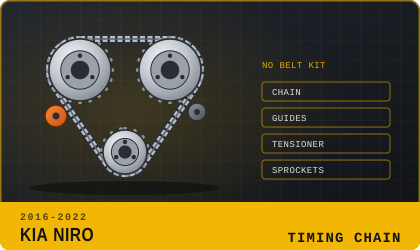 Illustration for editorial purposes
Opens live listings in a new tab.
Fitment Summary: Chain-Driven Engines
| 1.6 GDi Hybrid and Plug-in Hybrid (Kappa) | Timing chain — no belt kit required |
|---|---|
| e-Niro / Niro EV | No engine, no timing component |
Context from the Theta II and Nu recalls for a Niro buyer
If you're cross-shopping against a larger Kia with a Theta II or Nu GDI engine, or considering a used one from the same range, Kia issued a confirmed recall covering the Sorento, Sportage, and Soul, among others, addressing machining errors during engine manufacture that left metal debris in the oil passages — capable of eventually scoring the connecting rod bearings and causing the engine to seize. This doesn't directly affect the smaller engines used in this specific model, but is useful to know as general context on a documented reliability issue within Kia's wider range.
Also, using a full synthetic oil of the correct specification, and staying on top of oil changes rather than extending intervals, is a sound habit for any engine, worth building into your routine regardless of which specific Kia you own.
Engine by engine: what drives the cams on the Niro
| DE (2016–2022), 1.6 Kappa hybrid/PHEV petrol | Timing chain — see confirmation above |
|---|---|
| SG2 (2022–present), 1.6 Kappa hybrid/PHEV petrol | Timing chain — no scheduled replacement interval |
Mileage, age and the repair bill
This is one of the rare maintenance items on the Kia Niro where skipping the schedule risks serious consequences. On the engines affected, a failure here tends to cause damage well beyond the part itself, making the interval more important than on almost any other component.
The Kia Niro's timing belt or chain's whole purpose is keeping the camshafts and crankshaft turning in exact synchronisation, so valves open and close at precisely the right moment relative to the pistons. On "interference" engines, a common design, a failed belt lets pistons and valves collide, with serious internal damage the result.
Opens live listings in a new tab.
Since this is a chain, not a scheduled belt job, this video is only relevant if you're diagnosing or responding to symptoms of tensioner wear — commonly reported from around 130,000km on these engines.
Warning signs, DIY difficulty and aftermarket adviceThese are the same regardless of make or model — see our full Timing Belt Guide for symptoms to watch for, confirming fitment against your VIN, and which aftermarket brands are worth trusting.
The same part on other modelsThe same part, covered across other Kia models.