
Kia Sportage Timing Belt: Intervals, Fitment & Warning Signs
A confirmed recall covers connecting rod bearing wear that can cause the engine to seize.
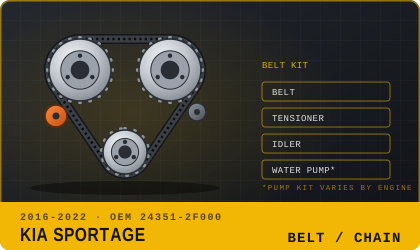 Illustration for editorial purposes
Opens live listings in a new tab.
OEM Part Number: 24351-2F000
| 2.0/2.2 CRDi diesel (D4HA/D4HB), genuine timing chain kit | Genuine reference: 24351-2F000 (also referenced as 243512F000, 24361-2F000) — shared across Sportage, Sorento, Santa Fe, Tucson |
|---|---|
| 2.0/2.4 Theta petrol, genuine timing chain kit | Genuine reference: 24321-2G111 (also referenced as 24322-2G111) — shared across Sportage, Sorento, Santa Fe, Tucson, Optima, Sonata |
The safety recall behind a knocking engine on the Sportage
This is critical to understand if your car has an affected Theta II or Nu GDI engine: Kia issued a confirmed recall covering machining errors during engine manufacture that left metal debris in the oil passages, which can break free over time and score the connecting rod bearings, eventually causing the engine to seize. If you ever hear a knocking noise from the bottom of the engine that gets louder with RPM, it's worth stopping the car and having it inspected immediately.
Bear in mind that using a full synthetic oil of the correct specification, and staying on top of oil changes, is worth prioritising given how directly oil quality relates to this specific failure mode.
Service deadlines for the Sportage: why a late job costs more
Almost nothing else on the Kia Sportage carries the same downside risk for being neglected. Where this component fails, the resulting damage usually goes far beyond the part itself, which is exactly why the replacement interval deserves more respect here than almost anywhere else.
On the Kia Sportage, camshaft and crankshaft rotation stays precisely synchronised thanks to the timing belt or chain, ensuring valves open and close exactly when piston position calls for it. Many engines are built to an "interference" design, where a belt failure allows pistons and valves to collide, with seriously damaging results.
Reading the Sportage engine list: belt-driven or chain-driven
| JE (2004–2010), all petrol & diesel | Timing belt — conventional dry belt |
|---|---|
| SL (2010–2016), all petrol & diesel | Timing chain — no scheduled replacement interval |
| QL (2016–2021), all petrol, diesel & GT-Line trim | Timing chain — GT-Line is a styling/handling package, not a different engine |
| NQ5 (2021–present), all petrol, diesel, hybrid & PHEV | Timing chain — no scheduled replacement interval |
Sportage shares its underlying engine architecture with the Hyundai Tucson of each equivalent era, so the same clear dividing line applies: 2010 is the cutover from belt to chain across the whole range, and every Sportage sold since has been chain-driven.
Opens live listings in a new tab.
Since this is a chain, not a scheduled belt job, this video is only relevant if you're diagnosing or responding to symptoms of tensioner wear — commonly reported from around 130,000km on these engines.
Warning signs, DIY difficulty and aftermarket adviceThese are the same regardless of make or model — see our full Timing Belt Guide for symptoms to watch for, confirming fitment against your VIN, and which aftermarket brands are worth trusting.
The same part on other modelsThe same part, covered across other Kia models.