
Kia Sportage Fuel Pump: Specs, Fitment & Common Faults
Confirmed: a recall covers a fuel pipe fault caused by a previous engine replacement — plus a real hesitation-before-failure pattern worth knowing and possible extended warranty coverage.
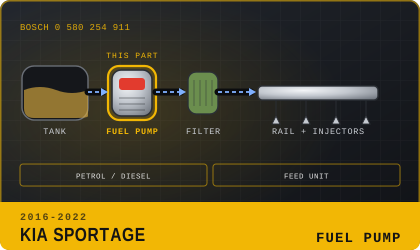 Illustration for editorial purposes
Opens live listings in a new tab.
OEM Part Number: confirm via VIN
Aftermarket units: Bosch 0 580 254 911 / Hüco 133543
| Fuel pumps / feed units (aftermarket) | Astemo 2503543 (complete diesel feed unit with fuel sender); Hüco 133543 (complete diesel feed unit with fuel sender); Hüco 133047 (petrol in-tank pump assembly, assembly information to be observed); Bosch 0 580 254 911 (in-line pump, universal fit); Ridex 458F0069 (diesel in-tank pump, 3.2 bar / 130 l/h, 2 connectors, 43 mm diameter); Magneti Marelli 313011300142 (petrol in-tank pump, 3 bar / 115 l/h, 12 V); ERA 770162A (in-tank pump, 3.2 bar / 120 l/h, 2 connectors, 38 mm diameter, repair kit 770162 offered); Ridex 458F0005 (petrol in-tank pump, 3.3 bar / 100 l/h, 38 mm diameter, 115 mm long). |
|---|---|
| Types & variants | The 1.7 and 2.0 CRDi diesels, which make up most UK cars, use an in-tank sender module with a lift pump; the Astemo 2503543 and Hüco 133543 are complete diesel modules with the sender, and the Ridex 458F0069 is a bare 43 mm diesel lift pump. Petrol 1.6 GDI and 1.6 T-GDI cars take a bare 38 mm in-tank pump at about 3 to 3.8 bar (Hüco 133047, Magneti Marelli, Ridex, ERA). |
| Genuine (OE) numbers quoted | 170429F500 (Meat & Doria 76416); 8450008680 (Kamoka 8410005). Neither is a Kia number; the Astemo and Hüco diesel modules carry no OE reference. |
| Fitment notes | Diesel and petrol modules are not interchangeable; the diesel Astemo or Hüco unit replaces the whole module including the gauge sender, while a bare lift pump or petrol cartridge is only a drop-in if the diameter, ports and plug match the original housing. |
Safety recalls covering supply to the Sportage's engine
If your Sportage previously had an engine replaced under warranty or a prior recall, Kia issued a confirmed recall (reference SC172) covering cars that had received an engine replacement under the earlier connecting rod bearing recall, addressing a high-pressure fuel pipe connecting to the fuel pump outlet that may have been damaged, misaligned, or improperly torqued during that earlier replacement procedure — creating a genuine fuel leak and fire risk. If your car has had an engine replaced for any reason, it's worth checking whether this specific follow-up recall was also completed.
Also, that Kia has, in some cases, extended fuel pump warranty coverage considerably beyond the car's original term on specific affected engines — worth checking with a dealer whether your specific engine and model year qualifies for any extended coverage.
Why the Sportage's pump fails when you need it most
On the Kia Sportage, few component failures are as inconveniently timed as this one — it has a habit of stranding drivers mid-journey rather than giving a clean warning while the car is safely parked. Knowing the early signs buys valuable time to get it sorted before that happens.
Watch: replacing itSportage generation not stated in title; verify it shows the QL rear-seat access before linking
The Kia Sportage's fuel pump draws fuel from the tank and delivers it to the engine at the pressure required for proper combustion. Almost all modern versions sit inside the fuel tank itself, submerged in fuel, which is partly why access for replacement is more involved than the part's small size might suggest.
Petrol, diesel and the Sportage's pump variants
| JE (2004–2010), all petrol & diesel | Spans both diesel (in-tank lift pump plus an engine-mounted high-pressure pump) and petrol (in-tank low-pressure pump, plus a separate high-pressure pump if direct-injection) variants — confirm your exact engine before ordering |
|---|---|
| SL (2010–2016), all petrol & diesel | Spans both diesel (in-tank lift pump plus an engine-mounted high-pressure pump) and petrol (in-tank low-pressure pump, plus a separate high-pressure pump if direct-injection) variants — confirm your exact engine before ordering |
| QL (2016–2021), all petrol, diesel & GT-Line trim | Spans both diesel (in-tank lift pump plus an engine-mounted high-pressure pump) and petrol (in-tank low-pressure pump, plus a separate high-pressure pump if direct-injection) variants — confirm your exact engine before ordering |
| NQ5 (2021–present), all petrol, diesel, hybrid & PHEV | Spans both diesel (in-tank lift pump plus an engine-mounted high-pressure pump) and petrol (in-tank low-pressure pump, plus a separate high-pressure pump if direct-injection) variants — confirm your exact engine before ordering — the hybrid system doesn't change this; the combustion engine still needs its own fuel pump |
Opens live listings in a new tab.
These are the same regardless of make or model — see our full Fuel Pump Guide for symptoms to watch for (including the low-pressure vs high-pressure distinction on direct-injection engines), confirming fitment against your VIN, and OE suppliers worth knowing.
The same part on other modelsThe same part, covered across other Kia models.