
Mercedes-Benz A-Class Exhaust System: Specs, Fitment & Common Faults
A "DPF not working efficiently" fault is most commonly caused by a failed, comparatively cheap pressure sensor rather than the expensive DPF itself — plus a finding that regeneration won't happen below around 15 litres of fuel.
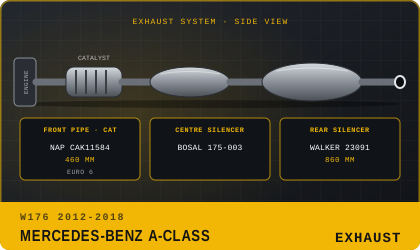 Illustration for editorial purposes
Opens live listings in a new tab.
OEM Part Number: confirm via VIN
Aftermarket rear silencers: Walker 23091
| Rear silencer (back box) — aftermarket | Walker 23091 (860 mm, code 52); Walker 24332 (1080 mm, code 63); Vegaz MS-22 / MS-2 / MS-6IMA / MS-13IMA / MS-332; Polmo 13.11; Hella 8LD 366 033-101 / -141 / -251 / -301, 034-901 (sets) |
|---|---|
| Centre / intermediate silencer — aftermarket | Bosal 175-003 / 175-123 / 175-185 / 175-429 / 176-421 (accessories needed); Ernst 350143 (770 mm), 350051 (800 mm); Vegaz MS-420, MS-421, MS-489 (rear, 1090 mm), MS-175IMA, MS-117; Izawit 07.009; Polmo 13.07; MTS 01.53450 |
| Front pipe / catalytic converter (DPF on diesels) — aftermarket | NAP CAK11584 (Euro 6, 460 mm), CAK11533 (Euro 6, 350 mm); Vegaz MK-400 (Euro 6), MK-319 (Euro 4); Walker 28962 / 20952 / 28196; Quinton Hazell QCAT80227H / 80180H; NAP CAK10455 (OM646/OM611 diesel codes); JMJ 1080252 (OM646); Ernst 465175 (front repair pipe) |
| Genuine (OE) numbers quoted | None quoted in catalogue listings — order genuine parts against your VIN |
| Fitment notes | petrol A160-A45 AMG, diesel A160 CDI-A220d; not engine-specific |
The sounds that point to exhaust trouble on the A-Class
On the Mercedes-Benz A-Class, most faults are things you'd spot visually first, but this one usually announces itself acoustically — a rattle, a drone, a noticeable jump in noise levels. That's actually helpful, since it means you'll likely notice trouble well before it gets serious.
What the exhaust does on the A-Class beyond carrying gas away
Three jobs happen inside the Mercedes-Benz A-Class's exhaust system: routing burnt gases away from the engine, quieting them through the silencer, and treating emissions via a catalytic converter and particulate filter. Petrol and diesel variants often need completely different systems to meet their respective emissions requirements.
Watch: replacing itAftermarket full exhaust fit on W176
Opens live listings in a new tab.
A cheaper fix for a DPF efficiency code
If a "DPF not working efficiently" fault code has appeared, this is useful to know on related diesel engines: this specific code is most commonly caused by a failed DPF differential pressure sensor, or a blockage in the pipes connecting it, rather than a fault with the expensive DPF itself. A replacement sensor is comparatively cheap and considered a straightforward DIY-friendly job, worth checking this specific sensor before assuming a full DPF replacement is necessary.
Note too that a dealer can check the DPF's fill level using their diagnostic equipment, and if it's found to be around 80% or higher, a good long run at higher revs on the motorway is typically the recommended first step before booking the car in for further investigation.
Warning signs, DIY difficulty and aftermarket adviceThese are the same regardless of make or model — see our full Exhaust System Guide for warning signs and fault codes to watch for, confirming fitment against your VIN, and which aftermarket brands are worth trusting.
The same part on other modelsThe same part, covered across other Mercedes-Benz models.