
Mercedes-Benz GLA Exhaust System: Specs, Fitment & Common Faults
A "DPF not working efficiently" fault on related engines is most commonly caused by a failed, comparatively cheap pressure sensor rather than the expensive DPF itself.
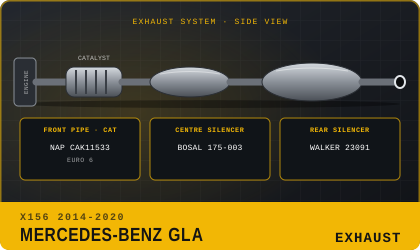 Illustration for editorial purposes
Opens live listings in a new tab.
OEM Part Number: confirm via VIN
Aftermarket rear silencers: Walker 23091 / MTS 01.65280
| Rear silencer (back box) — aftermarket | Walker 23091; Walker 24332; Vegaz MS-22, MS-2, MS-13IMA, MS-6IMA, MS-340; Polmo 13.11; MTS 01.65280, 01.95530; Hella 8LD 366 033-101 / -141 / -251 / -301 (sets) |
|---|---|
| Centre / intermediate silencer — aftermarket | Bosal 175-003 / 175-023 / 175-123 / 175-185 / 175-191 / 175-429 / 176-421 (accessories needed); Izawit 07.009; MTS 01.53450; Vegaz MS-302, MS-117, MS-145, MS-300; Polmo 13.07, 13.08 |
| Front pipe / catalytic converter (DPF on diesels) — aftermarket | NAP CAK11533 (Euro 6); Walker 28962, 28196; Vegaz MK-832; BM Catalysts BM80772H (Euro 4); IMASAF 49.15.33 (Euro 6); Oyodo 20N0042-OYO; JMJ 1080252 (OM646), 1080386 (OM651) |
| Genuine (OE) numbers quoted | None quoted in catalogue listings — order genuine parts against your VIN |
| Fitment notes | petrol GLA 180-45 AMG, diesel 180-220 CDI, flex; not engine-specific; same generic Mercedes pool. |
When the GLA's exhaust gets louder, and why
On the Mercedes-Benz GLA, this is one part where you'll usually hear the fault before you see it — a rattle, a drone, a sudden increase in noise that wasn't there last week. That's actually useful, since it gives you a head start on catching problems early.
The sections that make up the GLA's exhaust
The Mercedes-Benz GLA's exhaust system channels burnt gases away from the engine, reduces noise through the silencer, and treats emissions through a catalytic converter and particulate filter before gases exit the tailpipe. Petrol and diesel versions often use entirely different systems due to different emissions treatment requirements.
Watch: replacing itTitle-only match, content unconfirmed (likely aftermarket)
Opens live listings in a new tab.
What the GLA's DPF readings mean
If a "DPF not working efficiently" fault code has appeared, this is useful to know on related diesel engines: this specific code is most commonly caused by a failed DPF differential pressure sensor rather than a fault with the expensive DPF itself. A replacement sensor is comparatively cheap and considered a straightforward DIY-friendly job.
A 100% DPF fill level triggers a normal regeneration cycle, but at 200% the car's computer actually blocks regeneration entirely, requiring a specialist-only "forced regeneration" instead.
Warning signs, DIY difficulty and aftermarket adviceThese are the same regardless of make or model — see our full Exhaust System Guide for warning signs and fault codes to watch for, confirming fitment against your VIN, and which aftermarket brands are worth trusting.
The same part on other modelsThe same part, covered across other Mercedes-Benz models.