
Mercedes-Benz C-Class Fuel Pump: Specs, Fitment & Common Faults
A genuinely important finding: a low fuel pressure fault code can also be triggered by a separate recall covering leaking fuel rails and injectors, completely unrelated to the pump itself — worth checking your VIN before assuming the pump has failed.
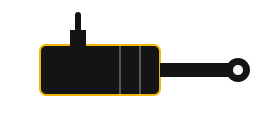 Illustration for editorial purposes
Opens live listings in a new tab.
OEM Part Number: A2054701594 (as quoted in catalogue listings — confirm via VIN) — aftermarket fuel pumps Bosch 0 580 204 30F / Hüco 132718
| Fuel pumps / feed units (aftermarket) | Hüco 132718 (complete feed unit, petrol, assembly information must be observed); Pierburg 7.03794.46.0 (complete feed unit, 3 bar, 1 connector, 129 mm flange, 230 mm long); Pierburg 7.03794.47.0 (second-side tank unit / suction-jet side, 0.5 bar, 2 connectors, 130 mm flange, 164 mm long); Bosch 0 580 204 30F (complete in-tank feed unit with fuel level sensor for the main tank side, connector parts included); Metzger 2250705 (complete feed unit, right-hand tank side, 11 pins, 1 connector); Metzger 2250626 (feed unit without sender, 8 pins); Delphi FG2776-12B1 (complete feed unit, without pressure sensor, without seal); Bosch 0 580 254 049 (in-line pump fitted in the fuel line). |
|---|---|
| Types & variants | The W205 has a saddle tank with two units: the pump-side feed unit at 3 bar (Pierburg 7.03794.46.0, Hüco 132718, Bosch 0 580 204 30F with the main sender) and the passive side with its own sender and transfer jet (Pierburg 7.03794.47.0 at 0.5 bar). The 8-pin Metzger 2250626, Stark SKFU-0410389 and Ridex 1382F0389 are the units without a sender; the 11-pin Metzger 2250705 and Topran 410 945 are the right-hand sender units. Ridex 1382F0121 is a mechanical gear-type diesel feed pump and Meat & Doria 76407 (0.24 bar / 75 l/h) a pre-supply pump. |
| Genuine (OE) numbers quoted | A2054701594 (Metzger 2250705); 205 470 4900 (Trucktec 02.38.145); 205 470 1694 (Trucktec 02.38.166); 357906092C (Meat & Doria 76407); recommended accessories A2055400017 and A0259971845 (Metzger 2250626). |
| Fitment notes | Identify which side of the saddle tank has failed before ordering, as the left pump unit, the right sender unit and the 8-pin no-sender variants are all different. Petrol and diesel W205 units differ as well, and the diesel's in-tank unit is low-pressure. No bare drop-in pump is offered for the module; the Delphi and Pierburg units come without a tank seal, which must be ordered separately. |
Mercedes-Benz C-Class Fuel Pump: A Part That Fails at the Worst Possible Moments
On the Mercedes-Benz C-Class, there's rarely a convenient time for this to fail — it tends to strike mid-journey rather than while the car's sitting safely on the drive. Knowing what the early symptoms look like buys valuable time to get ahead of it.
Mercedes-Benz C-Class Fuel Pump: What It Does
The job here is simple in principle — draw fuel from the tank, deliver it to the engine at the right pressure — but the Mercedes-Benz C-Class's fuel pump sits submerged inside the tank, which makes physical access for replacement far more involved than the small part itself implies.
Mercedes-Benz C-Class Fuel Pump: Generations & Engines: Fuel Pump Type
| W203/W204 (2000–2014), M271/OM651 petrol & diesel | Spans both diesel (in-tank lift pump plus an engine-mounted high-pressure pump) and petrol (in-tank low-pressure pump, plus a separate high-pressure pump if direct-injection) variants — confirm your exact engine before ordering |
|---|---|
| W204/W205 C63 AMG (2007–2018), 6.2/4.0 V8 | Petrol: typically a single in-tank low-pressure pump; some later or higher-output variants may add a separate engine-mounted high-pressure pump for direct injection — confirm your exact engine |
| W205/W206 (2014–present), M264 petrol & OM654 diesel | Spans both diesel (in-tank lift pump plus an engine-mounted high-pressure pump) and petrol (in-tank low-pressure pump, plus a separate high-pressure pump if direct-injection) variants — confirm your exact engine before ordering |
Mercedes-Benz C-Class Fuel Pump: Watch: Replacing It
W205 in-tank module
Opens live listings in a new tab.
A Genuinely Important Finding Worth Knowing Before Replacing This Pump — Mercedes-Benz C-Class Fuel Pump
If a low fuel pressure fault code has appeared, this is genuinely important to know before assuming the fuel pump itself has failed: this exact fault code can also be triggered by a separate, confirmed recall covering leaking fuel rails and injectors, worth checking your specific VIN against the official recall register before replacing any parts, since this recall-related cause is completely unrelated to the pump itself. It's also genuinely worth checking for fuel contamination in the engine oil, which can indicate a deeper underlying issue, before committing to a pump replacement based on the fault code alone.
It's genuinely worth knowing that driving with this fault present is possible for a short distance, but the engine may stall unexpectedly or enter a reduced-power mode, which can be dangerous in traffic — worth minimising driving until the problem is properly diagnosed and fixed.
Mercedes-Benz C-Class Fuel Pump: Warning Signs, DIY Difficulty & Aftermarket Advice
These are the same regardless of make or model — see our full Fuel Pump Guide for symptoms to watch for (including the low-pressure vs high-pressure distinction on direct-injection engines), confirming fitment against your VIN, and OE suppliers worth knowing.
More Mercedes-Benz Fuel Pump
The same part, covered across other Mercedes-Benz models.