
Nissan Leaf Battery: Specs, Fitment & Common Faults
Confirmed: Nissan themselves officially acknowledged this exact 12V drain issue — plus a technical root cause on pre-2018 cars: a telematics unit endlessly searching for defunct network towers.
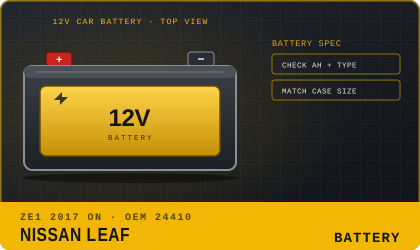 Illustration for editorial purposes
Opens live listings in a new tab.
OEM Part Number: 24410
| Gen 1.5 Leaf (24kWh), genuine reference | Nissan OEM: 24410 JD11A |
|---|---|
| Confirmed physical fitment | Type 012, approximately 175mm width x 210mm depth x 190mm height |
| US-spec equivalent (for reference) | BCI Group 51R — some UK owners have successfully fitted a larger Group 124R for improved reserve capacity, with a hold-down bar modification |
A 12V drain Nissan acknowledged on the Leaf
A widely documented 12V battery drain affects the Leaf, and Nissan issued an official statement acknowledging that many cars have shown this exact problem — this isn't simply forum speculation, but a confirmed, manufacturer-acknowledged issue. One owner built their own voltage logger and found a significant, repeating current draw every 14 minutes, peaking at 3.6A, clearly showing a parasitic drain rather than the battery itself being at fault. If your Leaf's 12V battery keeps going flat despite being replaced or testing fine, you're very likely not dealing with a simple bad battery.
Bear in mind that that Nissan customer service has, in some documented cases, been dismissive of this well-established issue — one owner was told they "must have left the lights on," despite the Leaf having no conventional mechanism for that to drain a 12V battery this way. If you're facing similar dismissiveness for a well-documented, manufacturer-acknowledged fault, it's worth pushing back and referencing Nissan's own public statement on the issue directly.
The usual suspect in a non-start, and the other culprits
On the Nissan Leaf, more non-starts get pinned on the battery than on any other single component, and that assumption is correct often enough to justify checking it first. It's not always the real cause, though, so it's worth confirming before spending money on a replacement that doesn't fix the problem.
Watch: replacing itThe 12V auxiliary battery, not the traction pack.
What the 12V system does
On the Nissan Leaf, every engine start and every moment the electrical systems run without the engine turning draws on the 12V battery. Stop-start puts far more demand on that battery than older designs, given how often the engine cycles off and on — hence the need for an AGM or EFB battery instead of a standard type.
Opens live listings in a new tab.
These are the same regardless of make or model — see our full Battery Guide for warning signs to watch for, confirming fitment against your VIN, and matching the right technology (standard, EFB, AGM) when buying aftermarket.
The same part on other modelsThe same part, covered across other Nissan models.