
Nissan Micra Battery: Specs, Fitment & Common Faults
On the Micra, a real diagnostic technique helps chase down a parasitic drain — plus a habit worth knowing that can flatten a battery fast.
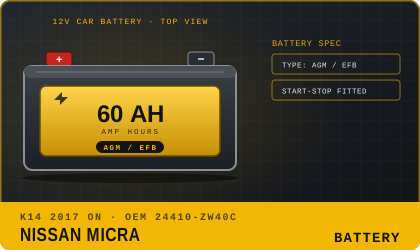 Illustration for editorial purposes
Opens live listings in a new tab.
OEM Part Number: 24410-ZW40C
| K14 generation (2017 onwards), Start/Stop | Type 027 (EFB), 60Ah, 560A (EN) — EFB is the required minimum, AGM is a valid further upgrade |
|---|---|
| K13 generation (2015-2019), genuine reference (discontinued) | Nissan OEM: 24410-ZW40C — replacement options include Group 121R (best reported fit) |
| Important | A standard flooded battery is not suitable on Start/Stop-equipped Micras — EFB is the required minimum. |
A clamp-meter test for the Micra's drain
If you're chasing a parasitic drain, an amp meter with a clamp attachment fitted over the positive battery cable allows you to monitor current draw while systematically pulling fuses one at a time — watching for the reading to drop identifies which specific circuit is causing the drain. It's worth prioritising checking permanently-live circuits first, since these are the most likely culprits.
Bear in mind that on some models in this range, battery problems have been widely enough documented that a premature failure on a relatively new car is worth raising with a dealer as a known pattern, rather than assuming you've simply had bad luck.
Symptom or cause: reading a non-start on the Micra
On the Nissan Micra, more non-starts get pinned on the battery than on any other single component, and that assumption is correct often enough to justify checking it first. It's not always the real cause, though, so it's worth confirming before spending money on a replacement that doesn't fix the problem.
Watch: replacing itFilmed on a K13 Micra.
Why the Micra needs a strong 12V supply even when parked
On the Nissan Micra, every engine start and every moment the electrical systems run without the engine turning draws on the 12V battery. Stop-start puts far more demand on that battery than older designs, given how often the engine cycles off and on — hence the need for an AGM or EFB battery instead of a standard type.
Opens live listings in a new tab.
These are the same regardless of make or model — see our full Battery Guide for warning signs to watch for, confirming fitment against your VIN, and matching the right technology (standard, EFB, AGM) when buying aftermarket.
The same part on other modelsThe same part, covered across other Nissan models.