
Peugeot 208 Engine Mount: Specs, Fitment & Common Faults
Peugeot confirmed internally being aware of a widespread mount knock issue without a fix — plus a real technician's trick that resolved it where a straightforward swap didn't.
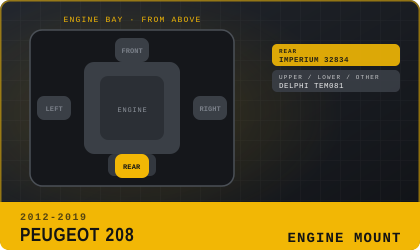 Illustration for editorial purposes
Opens live listings in a new tab.
OEM Part Number: confirm via VIN
Aftermarket mountings: Febi 174479 / Corteco 80001814
| Engine Mount — Rear lower (aftermarket) | Original Imperium 32834, Maxgear 40-0314 |
|---|---|
| Engine Mount — Rear (aftermarket) | Mapco 36278, Febi 174479 |
| Engine Mount — Lower (aftermarket) | Delphi TEM081, Corteco 80001814 |
| Genuine (OE) number | Not quoted in the catalogue listings — mounts differ by engine and gearbox, so order the genuine ones against your VIN |
| Fitment notes | The listing above shows examples for the engines checked; petrol, diesel, manual and automatic versions often use different mounts, and cars usually have more than one mount. |
Speed-bump knocks on the 208
If you're chasing a knock over speed bumps that seems to come from the engine mount area but keeps returning after repairs, this is useful to know about: a documented forum thread from a 208 owner describes their dealer confirming directly that Peugeot was internally aware of a widespread engine mount knocking issue and was "looking for a fix" — while the owner's own car continued knocking despite the top and bottom mounts already being greased under warranty. The owner had raised a formal complaint months earlier with no resolution by the time of posting, and speculated the issue could affect a meaningful proportion of 208s from that era. If you're experiencing a persistent, hard-to-fix mount knock, it's worth asking your dealer directly whether an updated part or revised fix now exists, since these things do sometimes get resolved with a later parts revision even if there wasn't one when the issue was first reported.
Worth knowing as a useful diagnostic clue: a knock that's noticeably louder going downhill than uphill points more toward the front shocks or struts extending and contracting under changing load, rather than the engine mount itself — worth mentioning this specific pattern to a technician if it matches what you're experiencing, since it helps narrow down which component is at fault.
Watch: replacing it
What the mountings soak up
Engine mounts secure the engine and transmission to the chassis while absorbing vibration and movement, preventing that vibration from transferring directly into the cabin. Most versions of the 208 use several mounts working together — typically at least one on each side of the engine plus a torque mount — and a single failed mount can throw off the whole assembly's balance.
Opens live listings in a new tab.
Warning signs and quality replacement mountings
These are the same regardless of make or model — see our full Engine Mount Guide for warning signs to watch for (including some make-specific quirks in how they show up), confirming fitment against your VIN, and which aftermarket approach is worth trusting.
The same part on other modelsThe same part, covered across other Peugeot models.