
Peugeot 208 Front Suspension Strut: Specs, Fitment & Common Faults
A useful clue: whether a knock changes with temperature points toward different causes — plus a free DIY test for track rod wear using nothing but bricks.
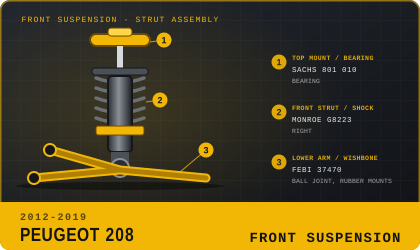 Illustration for editorial purposes
Opens live listings in a new tab.
OEM Part Number: confirm via VIN
Aftermarket front struts: Bilstein 22-225221 / KYB 3338012
| Front strut / shock absorber (aftermarket) | Monroe G8223 (right) / G8224 (left); Monroe G8221 / G8222; Bilstein 22-225221 (B4, right) / 22-225214 (left); KYB 3338012 (right) / 3338013 (left); KYB 3338014 (right) / 3338015 (left); Daco 452809R/L and 452810R/L. All gas twin-tube. |
|---|---|
| Front lower arm / wishbone (aftermarket) | LH febi 37470 (ball joint, rubber mounts), Delphi TC2983, Delphi TC3707, TRW JTC1234, NTY ZWD-CT-022; RH febi 37471, Delphi TC2984, Delphi TC3708, Ridex 273C1213, NTY ZWD-CT-023 |
| Top mount / strut bearing (aftermarket) | Sachs 801 010 (bearing); Sachs 803 071 (mount); SNR KB659.36 / KB659.06 (kits with ball bearing); febi 39133 (elastomer, no bearing); Metalcaucho 05902 (kit with rolling bearing) |
| Genuine (OE) numbers quoted | Sachs 801 010 bearing: 3637192, 5035 19, 5035 23, 5035 27, 5035 58, 5035 63, 54612-1G010, 54612-2C000, 91510633; Sachs 803 071 mount: 5038 H4, 5038G6, 96 708 307 80. None quoted for struts or arms. |
| Fitment notes | Two housing diameters (47 mm and 51 mm) appear with no engine split, so check the existing strut. |
How warming up changes the 208's knock, and why it matters
A well-documented, useful pattern worth paying attention to: whether a knock gets better or worse as the car warms up during a drive points toward different specific causes. A knock that's prominent when cold and largely disappears after driving for a while often points toward a worn top mount or strut bearing, which behaves differently as the rubber components warm and flex more freely. A knock that instead appears or worsens after around 30 minutes of driving, particularly at slow speeds, has been traced in documented cases to worn steering tie rods rather than the suspension itself — worth mentioning this specific timing pattern to a technician, since it's a useful clue for narrowing down the cause faster than generic trial and error.
This platform has a well-documented reputation for knocks that survive an initial repair — multiple documented cases describe drop links, top mounts, or ball joints being replaced without the noise actually resolving, sometimes requiring several visits and multiple components addressed before the actual cause is found. This isn't necessarily a sign of an incompetent garage; it reflects a stubborn platform characteristic where more than one worn component can be masking or mimicking another's symptoms. Real cost figures worth knowing: top mount replacement has been quoted around £60 in parts plus £80 labour on the 208 specifically.
The load the 208's front end carries on every drive
On the Peugeot 208, these components absorb every pothole, bump and cornering force before any of it reaches the cabin, which is why deterioration here rarely announces itself with one obvious symptom. Working through it methodically finds the actual cause faster than guessing ever will.
Watch: replacing it208 first-gen front strut
What the damper and spring do together on the 208
The Peugeot 208's front strut does two jobs in one unit — damping the suspension's movement and providing the coil spring's mounting point. Wear here shows up as excessive bounce after bumps rather than a quick settle, and left long enough, uneven tyre wear tends to follow.
Opens live listings in a new tab.
These are the same regardless of make or model — see our full Front Suspension Strut Guide for symptoms of worn bushings and ball joints, confirming fitment against your VIN, and rubber vs polyurethane guidance.
The same part on other modelsThe same part, covered across other Peugeot models.