
Peugeot 308 Front Suspension Strut: Specs, Fitment & Common Faults
On the 308, whether a knock changes with temperature is a genuinely useful diagnostic clue — plus a real, free DIY test for track rod wear.
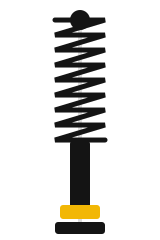 Illustration for editorial purposes
Opens live listings in a new tab.
OEM Part Number: 1628564280 (front strut, as quoted in catalogue listings — confirm via VIN) — aftermarket struts Bilstein 22-242020 / KYB 3348036
| Front strut / shock absorber (aftermarket) | Bilstein 22-242020 and 22-251183 (B4); Bilstein 35-243984 (B6 Performance, monotube upside-down); KYB 3348036 (Excel-G); Meyle 40-26 623 0028; Maxgear 11-0645; Optimal A-5089G; Citroen/Peugeot 1628564280 (OE-supplied). Side not stated |
|---|---|
| Front lower arm / wishbone (aftermarket) | LH febi 174578 (without ball joint, rubber mounts), Delphi TC2985, Delphi TC3450 (aluminium, with ball joint), Ridex 273C0729, TRW JTC3108, Meyle 11-16 050 0115 (with ball joint); RH febi 174577, Delphi TC2986, Delphi TC3451, Meyle 11-16 050 0114, TRW JTC7914 |
| Top mount / strut bearing (aftermarket) | Sachs 801 061 (no rolling bearing); Ridex 1180S0402 and Stark SKSS-0670403 (ball bearing, SNR); febi 183313 (ball bearing, elastomer); SNR KB659.62; Maxgear 72-4554; Sidem 853451 |
| Genuine (OE) numbers quoted | Citroen/Peugeot 1628564280 strut is marked as an OE part but no separate OE number is given. |
| Fitment notes | Mostly standard twin-tube; B6 is the only sport option. Both aluminium and steel arm variants appear, so confirm which the car has. Meyle arms are marked not for Citroen. |
A Genuinely Useful Diagnostic Clue: Does the Knock Change With Temperature? — Peugeot 308 Front Suspension
A genuinely well-documented, useful pattern worth paying attention to: whether a knock gets better or worse as the car warms up during a drive points toward different specific causes. A knock that's prominent when cold and largely disappears after driving for a while often points toward a worn top mount or strut bearing, which behaves differently as the rubber components warm and flex more freely. A knock that instead appears or worsens specifically after around 30 minutes of driving, particularly at slow speeds, has been traced in documented cases to worn steering tie rods rather than the suspension itself — worth mentioning this specific timing pattern to a technician, since it's a genuinely useful clue for narrowing down the cause faster than generic trial and error.
It's also genuinely worth knowing that this platform has a well-documented reputation for knocks that survive an initial repair — multiple documented cases describe drop links, top mounts, or ball joints being replaced without the noise actually resolving, sometimes requiring several visits and multiple components addressed before the actual cause is found. This isn't necessarily a sign of an incompetent garage; it reflects a genuinely stubborn platform characteristic where more than one worn component can be masking or mimicking another's symptoms. Real cost figures worth knowing: top mount replacement has been quoted around £60 in parts plus £80 labour on the 208 specifically.
Peugeot 308 Front Suspension Strut: The System That Quietly Does All the Work
Everything the road throws at the Peugeot 308 — bumps, potholes, cornering loads — passes through these components before it reaches the cabin, so wear here tends to show up as vague symptoms rather than one clear failure point. A systematic check beats guesswork every time.
Peugeot 308 Front Suspension Strut: Watch: Replacing It
T9 named in title; alt O4r3vTJvQ50 (front strut, spring, top mount)
Peugeot 308 Front Suspension Strut: What It Does
On the Peugeot 308, the front suspension strut combines a shock absorber and the coil spring's mounting point into a single assembly, controlling how the suspension compresses and rebounds. Once it wears, the car keeps bouncing after a bump instead of settling quickly, and tyre wear often becomes uneven if it's left unresolved.
Opens live listings in a new tab.
Peugeot 308 Front Suspension Strut: Warning Signs, DIY Difficulty & Aftermarket Advice
These are the same regardless of make or model — see our full Front Suspension Strut Guide for symptoms of worn bushings and ball joints, confirming fitment against your VIN, and rubber vs polyurethane guidance.
More Peugeot Front Suspension Strut
The same part, covered across other Peugeot models.