
Renault Captur Radiator: Specs, Fitment & Common Faults
On the Captur, a well-corroborated diagnosis: "95% chance it's the thermostat housing" — a cheap, common fix.
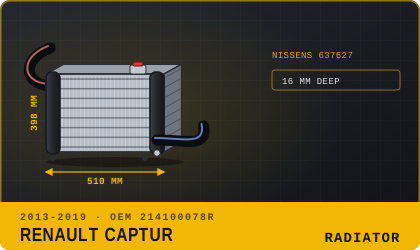 Illustration for editorial purposes
Opens live listings in a new tab.
OEM Part Number: 214100078R
As quoted in catalogue listings, confirm via VIN. Aftermarket units: Nissens 637627 / Valeo 701120
| Radiators (aftermarket) | Nissens 637627 (510 x 398 x 16 mm, with gaskets/seals); Nissens 637624 (511 x 408 x 26 mm, with gaskets/seals); Valeo 701120 (398 x 510 x 16 mm, for vehicles without oil cooler, without coolant regulator); Denso DRM37002 (511 x 392 x 18 mm); NRF 58443 (510 x 407 x 26 mm); NRF 58444A (513 x 414 x 23 mm); NRF 58443A (510 x 407 x 24 mm); NRF 58444 (510 x 398 x 16 mm) |
|---|---|
| Core sizes & variants | 510 mm wide core; 16 mm deep for the 0.9 TCe and 1.2 TCe petrols, 26 mm for the 1.5 dCi diesel. |
| Genuine (OE) numbers quoted | 214100078R |
| Fitment notes | Same radiator as the Clio IV; the Captur II from 2020 uses a different unit and must not be confused. |
The plastic thermostat housing on the Captur
If your car has the 0.9 or 1.2 TCe engine and you're chasing a slow coolant leak, one owner's own assessment after extensive research put it plainly — "95% chance it is thermostat housing." This is a well-documented, common failure point on these engines, and good news on cost: one documented repair came to around £85-100.
Bear in mind that you're not imagining a problem if this feels like a common complaint: multiple owners and independent motoring columns have confirmed that this generation of small turbocharged engines leaks coolant in significant numbers, and if a dealer is dismissive of a repeated coolant loss without a proper investigation, it's worth pushing back rather than accepting a simple "topped up, no fault found" response.
How the cooling system stops the Captur overheating
It's an unglamorous part, but on the Renault Captur, the cooling system is behind almost every serious non-wear engine failure that could have been prevented. Spotting trouble here early is about as cheap an insurance policy as exists against an expensive repair bill.
Watch: replacing itClosest video found; the radiator comes out the same way once the front panel and fan are off

How the cooling pack works
On the Renault Captur, heat from the engine coolant is shed to the surrounding air through the radiator, keeping engine temperature in a safe range. On automatic gearboxes, it often doubles up, cooling transmission fluid through a separate internal circuit too — which is why getting the exact part number right matters more here than on a simple heat exchanger.
Opens live listings in a new tab.
These are the same regardless of make or model — see our full Radiator Guide for the three common failure modes, confirming fitment against your VIN, and OEM vs aftermarket guidance.
The same part on other modelsThe same part, covered across other Renault models.