
Renault Clio Fuel Pump: Specs, Fitment & Common Faults
A genuinely severe, well-documented HPFP fault on the 1.5 dCi — with real, dramatically varying quotes (£1,300-£3,500+ dealer vs ~£1,200 independent vs one case fixed for £100).
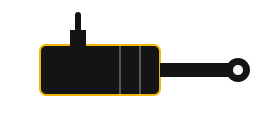 Illustration for editorial purposes
Opens live listings in a new tab.
Renault Clio Fuel Pump: OEM Part Number
A Genuinely Severe, Well-Documented Fault on the 1.5 dCi — And a Real Cost Comparison Worth Knowing — Renault Clio Fuel Pump
If your car has the 1.5 dCi diesel engine, particularly an early example, this is genuinely worth understanding given how consistently and severely it's documented: the rollers inside the high-pressure fuel pump can disintegrate, sending metal filings throughout the entire fuel system — the rail, all the injectors, and the associated pipework. This is confirmed across numerous independent forum threads as a known, recognised fault among mechanics familiar with this specific engine.
It's worth getting a second opinion and a specialist assessment of exactly what's failed before accepting the most expensive quote as the only option — while genuine metal contamination throughout the system does sometimes require the full replacement, it isn't automatically true in every case.
Renault Clio Fuel Pump: A Part That Fails at the Worst Possible Moments
Rather than failing conveniently while parked, this component on the Renault Clio tends to give up mid-journey, which is about the worst possible moment. Learning to recognise the early symptoms is the best defence against being caught out.

Renault Clio Fuel Pump: What It Does
The Renault Clio's fuel pump function — pulling fuel from the tank and pressurising it for the engine — is straightforward, but its usual location isn't: it sits submerged inside the tank itself, which is precisely why access for replacement is more work than the part's size suggests.
Renault Clio Fuel Pump: Generations & Engines: Fuel Pump Type
| Mk2 (1998–2005), K7M/K4M 1.6 petrol | Petrol: typically a single in-tank low-pressure pump; some later or higher-output variants may add a separate engine-mounted high-pressure pump for direct injection — confirm your exact engine |
|---|---|
| Mk2 RS 172/182 (2000–2005), 2.0 F4R petrol | Petrol: typically a single in-tank low-pressure pump; some later or higher-output variants may add a separate engine-mounted high-pressure pump for direct injection — confirm your exact engine |
| Mk3 (2005–2012), K4M 1.6 & D4F 1.2 petrol | Petrol: typically a single in-tank low-pressure pump; some later or higher-output variants may add a separate engine-mounted high-pressure pump for direct injection — confirm your exact engine |
| Mk3 RS 197/200 (2006–2012), 2.0 F4R petrol | Petrol: typically a single in-tank low-pressure pump; some later or higher-output variants may add a separate engine-mounted high-pressure pump for direct injection — confirm your exact engine |
| Mk2/Mk3, 1.5 dCi diesel (K9K) | Diesel: in-tank lift pump feeds a separate engine-mounted high-pressure injection pump (common rail) — never interchangeable with the petrol pump |
| Mk4 (2012–2019), Energy TCe 0.9/1.2 turbo petrol | Petrol (direct injection): in-tank low-pressure pump plus a separate engine-mounted high-pressure pump |
| Mk4 RS200 (2013–2019), 1.6 turbo (Nissan-sourced MR16DDT) | Petrol: typically a single in-tank low-pressure pump; some later or higher-output variants may add a separate engine-mounted high-pressure pump for direct injection — confirm your exact engine |
| Mk5 (2019–present), TCe petrol | Petrol (direct injection): in-tank low-pressure pump plus a separate engine-mounted high-pressure pump |
Opens live listings in a new tab.
Renault Clio Fuel Pump: Warning Signs, DIY Difficulty & Aftermarket Advice
These are the same regardless of make or model — see our full Fuel Pump Guide for symptoms to watch for (including the low-pressure vs high-pressure distinction on direct-injection engines), confirming fitment against your VIN, and OE suppliers worth knowing.
More Renault Fuel Pump
The same part, covered across other Renault models.