
Toyota Auris Alternator: Specs, Fitment & Common Faults
On the Auris, a free diagnostic test reveals whether a whine is a bearing fault, not the alternator.
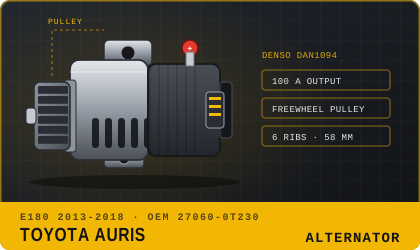 Illustration for editorial purposes
Opens live listings in a new tab.
OEM Part Number: 27060-0T230
Genuine alternator, confirm via VIN. Aftermarket alternators: Denso DAN1094 / AS-PL A6897S
| Alternators (aftermarket) | Denso DAN1094 (100 A, freewheel clutch pulley, 6 ribs, 58 mm, new OE quality); Denso DAN1096 (90 A, freewheel, 6 ribs, 55 mm, new OE quality); Denso DAN1098 (100 A, freewheel, 6 ribs, 55 mm, new OE quality, £6.91 core charge); Denso DAN1420 (100 A, freewheel, 6 ribs, 55 mm, new OE quality); Denso DAN1093 (100 A, 4 ribs, 63 mm, new OE quality); AS-PL A6897S (100 A, freewheel, 7 ribs, 58 mm, new Standard Line, plug PL_1100, OE 104211-3140); AS-PL A3929S (85 A, freewheel, 4 ribs, 52.5 mm, new Standard Line, plug PL_1100, OE FG9T015); AS-PL A3564S (150 A, rigid pulley, 5 ribs, 54 mm, new Standard Line, plug PL_2306, OE TG15C200) |
|---|---|
| Outputs & variants | 90-100 A freewheel 6-rib 55 mm (DAN1096 / DAN1098 / DAN1420) for the 1.33 and 1.6 petrol; 100 A freewheel 6- or 7-rib 58 mm (DAN1094, Denso 104211-3140) for the 1.4 D-4D and 2.0 D-4D; 100 A 4-rib 63 mm (DAN1093) is the earlier 1.8 hybrid-related pattern; 150 A rigid 5-rib (TG15C200) for the 2.0 D-4D with heavy electrical load |
| Genuine (OE) numbers quoted | 104211-3140 (AS-PL A6897S); FG9T015 (AS-PL A3929S); TG15C200 (AS-PL A3564S); DAN1093 (AS-PL A6250 Denso) |
| Fitment notes | the 1.8 Hybrid has no conventional alternator and uses a DC-DC converter instead; Walker WAL01471 is a reman exchange with a £50.24 core charge. |
Isolating the source of a whine on the Auris
If you're hearing a whine or grinding noise that might be the alternator, with the engine idling, listen to the noise, then progressively add electrical load — headlights, heated rear window, air conditioning. A genuine bearing fault typically gets louder as load increases. It's also worth listening for whether the noise briefly disappears then returns a second or two after decelerating from higher revs — this pattern is a fairly reliable sign of genuine bearing wear.
Bear in mind that a breakdown recovery call-out for alternator failure, particularly away from home, can come with a real premium attached.
Why a weak battery and a tired charging unit get confused
Early on, a weak Toyota Auris battery and a dying alternator look almost identical — dim lights, sluggish starts, a car that won't hold its charge — which is exactly why so many people fit a new battery and end up back at the garage weeks later, the actual fault still unaddressed.
Watch: replacing itAuris generation not stated in title; verify it is the E180 before embedding
How the Auris keeps its battery topped up
On the Toyota Auris, while the engine runs, the alternator generates the electricity that charges the battery and powers the car's electrical systems directly. With a healthy alternator, the battery's real job becomes starting the engine and covering brief demand spikes, rather than running the electronics on its own.
Opens live listings in a new tab.
These are the same regardless of make or model — see our full Alternator Guide for symptoms to watch for (plus a useful two-minute test to confirm it's not the battery instead), confirming the right amperage and fitment against your VIN, and which brands are worth trusting.
The same part on other modelsThe same part, covered across other Toyota models.