
Toyota Aygo Exhaust System: Specs, Fitment & Common Faults
On the Aygo, if diesel, attempting a motorway "regen" while the engine management light is already on is often genuinely futile.
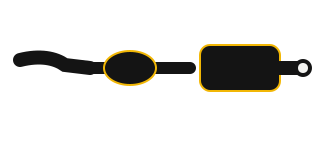 Illustration for editorial purposes
Opens live listings in a new tab.
OEM Part Number: confirm via VIN — Rear silencer (aftermarket) Bosal 228-407 / Walker 22203
| Rear silencer (back box) — aftermarket | Bosal 228-407, 228-477, 228-063 (accessories needed); Walker 22203 (940mm, code 52, no fittings); Asmet 20.036, 20.029; MTS 01.97470 (940mm), 01.60957 (860mm); Vegaz TS-226; Polmo 26.02 (cat-prep), 26.177; Izawit 35.013 |
|---|---|
| Centre / intermediate silencer — aftermarket | Bosal 228-251 (accessories); Walker 22017 (710mm, code 62), 22418 (700mm), 22018 (580mm), 23695 (1100mm); Izawit 35.001, 35.043; Vegaz TS-232, TS-278; Polmo 26.19/26.22/26.280 |
| Front pipe / catalytic converter (DPF on diesels) — aftermarket | Bosal 090-309 (Euro 6.2), 090-303 (Euro 5/6); Walker 28816 (285mm), 20951 (340mm); Vegaz TK-871 (Euro 5/6), PGK-805QP; Asmet (listed "AS") 95160, 95177; BM Catalysts BM92642H (Euro 6, FK92642); JMJ 1091031 (340mm, engine 1KR-FE/384F) |
| Genuine (OE) numbers quoted | None quoted in catalogue listings — order genuine parts against your VIN |
| Fitment notes | 1.0 and 1.2 petrol only |
A Genuinely Important Point Worth Knowing Before Attempting a Motorway "Regen" — Toyota Aygo Exhaust System
If your diesel's engine management light has already illuminated, this is genuinely important to know before spending time and fuel on a hard motorway run: a proper regeneration cycle generally can't occur while the engine management light is on, since it indicates an underlying fault the ECU needs resolved first. Attempting to "drive it out" at this stage is often genuinely futile — the fault causing the light needs diagnosing and fixing before regeneration can succeed.
It's also worth knowing that a recurring EGR-related fault code that returns despite cleaning points toward the valve needing replacement rather than further cleaning.
Toyota Aygo Exhaust System: The Part That Announces Its Own Problems
On the Toyota Aygo, this is one part where you'll usually hear the fault before you see it — a rattle, a drone, a sudden increase in noise that wasn't there last week. That's actually useful, since it gives you a head start on catching problems early.
Toyota Aygo Exhaust System: Watch: Replacing It
Back box replacement; title names Aygo, but could not confirm it is the 2014-21 car rather than the 2005-14 one. Fallback: https://www.youtube.com/watch?v=YDHthpvvaTQ
Toyota Aygo Exhaust System: What It Does
The Toyota Aygo's exhaust system channels burnt gases away from the engine, reduces noise through the silencer, and treats emissions through a catalytic converter and particulate filter before gases exit the tailpipe. Petrol and diesel versions often use entirely different systems due to different emissions treatment requirements.
Opens live listings in a new tab.
Toyota Aygo Exhaust System: Warning Signs, DIY Difficulty & Aftermarket Advice
These are the same regardless of make or model — see our full Exhaust System Guide for warning signs and fault codes to watch for, confirming fitment against your VIN, and which aftermarket brands are worth trusting.
More Toyota Exhaust System
The same part, covered across other Toyota models.