
Volkswagen Golf Rear Bumper: Fitment, Sensors & Common Damage
On the Golf, some cars have genuine reversing camera hardware fitted but never activated at the factory — confirmed by a case where wiring existed but coding never happened.
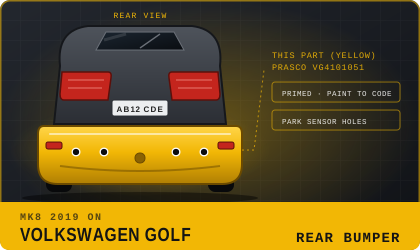 Illustration for editorial purposes
Opens live listings in a new tab.
OEM Part Number: confirm via VIN
Aftermarket covers: Prasco VG4101051 / Van Wezel 5711547
| Rear bumper covers (aftermarket) | Prasco VG4101051 (Rear, for vehicles with parking sensors, primed); Van Wezel 5711547 (Rear, R-Line); Van Wezel 5711545 (Rear, primed, with holes for parking sensors); Van Wezel 5711544 (Rear, primed, without holes for parking sensors); Van Wezel 5711546 (Rear, primed, with holes for park assist); Diederichs 2218055 (Rear, for vehicles without parking sensors, primed) |
|---|---|
| Lower sections, corners & trims | None listed separately |
| Genuine (OE) numbers quoted | None quoted in the catalogue listings — the genuine cover varies by body style, parking sensors and tow bar, so order it against your VIN |
| Fitment notes | Match body style, facelift date and the holes for parking sensors or exhaust trims; covers come primed and need painting to your paint code before fitting. |
As with the front bumper, expect the rear cover to vary by trim (GTI/R-Line/Golf R differ from standard SE/Style), colour code, and whether the car has rear parking sensors — a bumper cover with sensor housings pre-cut isn't the same part as a sensor-free version.
Before buying a camera for the Golf, check this
A distinctive, documented pattern — check this before assuming a reversing camera fault: some cars are built with the physical camera hardware and wiring present — including in one case the washer pipe for the camera lens connected and everything — but the camera was simply never activated or coded at the factory, meaning it's physically there but functionally inert. This is worth checking before paying for expensive diagnostics on a camera you'd otherwise assume has failed; activation on a genuinely-fitted-but-uncoded camera typically requires VAG-specific tooling (ODIS or equivalent) to add the module into the car's gateway list and complete a proper calibration, which most independent VAG specialists (not just main dealers) can do.
If you're having a towbar fitted, the trailer control module does more than provide power to the socket — it automatically disables the rear parking sensors and rear fog lights, and adjusts ABS/traction control logic, when it detects a trailer plugged in. Never allow a fitter to simply splice the tow socket's lighting directly into the existing wiring rather than using a proper module — doing so bypasses this logic entirely and can cause both the car's own systems and the trailer's lights to behave unpredictably.
How much the back panel of the Golf carries
Kerb damage to the Volkswagen Golf's rear bumper is common, but the repair often isn't as simple as it looks: it houses parking sensors, a reversing camera, and sometimes exhaust trim finishers, all of which complicate what would otherwise be a straightforward panel replacement.
The sequence is much the same on this generation: wheel-arch liner screws, the fixings along the boot aperture and under the lower edge, then unclip each corner from the wing and unplug any sensor loom before the cover comes away.

The tail-end structure of the Golf, explained
Beyond absorbing minor impacts, the rear bumper on higher trims of the Golf often houses parking sensors, a reversing camera, and sometimes integrated exhaust finishers. A bumper that looks compatible can still be missing the correct cutouts or wiring provisions for your specific trim's equipment.
Generations, Derivatives and Colour| Mk7 pre-facelift (2012–2017), standard trims | Colour-coded to body — common shades included Pure White, Deep Black Pearl, Tungsten Silver, Urano Grey |
|---|---|
| Mk7 GTI (2013–2017) | Colour-coded to body — Tornado Red, Pure White and Nardo Grey (limited edition) were popular GTI-specific shades; the rear bumper is also styled differently on this trim |
| Mk7 R (2014–2017) | Colour-coded to body — Tornado Red, Deep Black Pearl and Lapiz Blue were offered; the rear bumper is also styled differently on this trim |
| Mk7.5 facelift (2017–2019), standard trims | Colour-coded to body — common shades included Pure White, Deep Black Pearl, Indium Grey; revised LED lighting signature and bumper trim vs pre-facelift |
| Mk7.5 R (2018–2019) | Colour-coded to body — narrowed to Lapiz Blue, Deep Black Pearl, Oryx White, and (market-dependent) Indium Grey |
| Mk8 (2019–present), standard trims | Colour-coded to body — common shades included Pure White, Deep Black Pearl, Moonstone Grey, Atlantic Blue |
| Mk8 GTI (2020–present) | Colour-coded to body — Tornado Red, Pure White, Moonstone Grey and Atlantic Blue; the rear bumper is also styled differently on this trim |
| Mk8 R (2020–present) | Colour-coded to body — deliberately limited to just three shades: Lapiz Blue Metallic, Pure White, and Deep Black Pearl, narrower than the rest of the Golf range; the rear bumper is also styled differently on this trim |
Opens live listings in a new tab.
Match your paint colour by shade name (not just "white" or "black" generically) when buying a used colour-coded bumper — VW has offered several distinct whites, blacks and greys across the Golf range that don't match each other. Your colour and paint code are on the VIN plate.
Common damage, DIY difficulty and aftermarket adviceThese are the same regardless of make or model — see our full Rear Bumper Guide for common damage types, confirming fitment (body style and sensor equipment matter here), and OEM vs aftermarket guidance.
The same part on other modelsThe same part, covered across other Volkswagen models.