
Hyundai i20 Fuel Pump: Specs, Fitment & Common Faults
On the i20, Hyundai has issued multiple genuine fuel pump recalls across various models — worth checking your specific VIN directly.
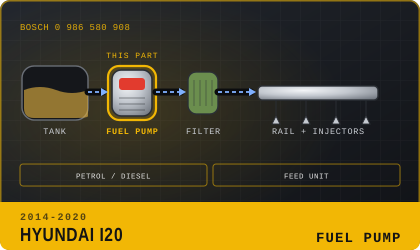 Illustration for editorial purposes
Opens live listings in a new tab.
OEM Part Number: confirm via VIN
Aftermarket units: Bosch 0 986 580 908 / Hüco 133518
| Fuel pumps / feed units (aftermarket) | Hüco 133518 (complete fuel feed unit, petrol, with sender); Hüco 133362 (bare pump, petrol, 3.8 bar); Bosch 0 986 580 908 (in-tank pump module with mounting and connector parts); Delphi FE0796-12B1 (bare pump, petrol, 113 mm, metal housing, without pressure sensor); Delphi FE0449-12B1 (bare pump, petrol, 116 mm, metal housing, without pressure sensor); Magneti Marelli 313011313206 (fuel supply module, 3 bar / 170 l/h); Meyle 37-14 919 0001 (bare pump, petrol, 3 bar / 95 l/h, 2 pins); Meat & Doria 76385 (bare pump, 3.5 bar / 90 l/h) |
|---|---|
| Types & variants | Petrol 1.2 and 1.4 MPi cars take a 3 to 3.5 bar bare pump or the Hüco 133518 module; the 1.0 T-GDI direct-injection engine still uses the same low-pressure in-tank feed (around 3.8 bar, Hüco 133362) with its high-pressure pump on the engine. The 1.1 and 1.4 CRDi diesels appear in the engine menu but no diesel lift unit is listed. |
| Genuine (OE) numbers quoted | 3111137300 (Meat & Doria 76385, Hoffer 7506385); 311110M000 (Kamoka 8410007); 170429F500 (Meat & Doria 76416, Hoffer 7506416); 8450008680 (Kamoka 8410005). |
| Fitment notes | Petrol only. Bare pumps fit into the original module and keep the sender; the Hüco 133518 replaces the whole feed unit with its sender. Delphi pumps come without seal or pressure sensor, so re-use or renew the tank ring seal. |
Whether the i20 is covered by a fuel system recall
Hyundai has issued multiple confirmed fuel pump recalls across various models and years, including issues with both the low-pressure in-tank pump and, on some turbocharged models, the high-pressure pump connection not being properly torqued during assembly — creating a genuine fuel leak and fire risk in the affected cases. It's worth checking your specific VIN against Hyundai's official recall checker directly, particularly on a used car where you can't be certain a previous owner had any relevant recall work completed.
Also, the documented symptoms worth watching for: engine hesitation or a "bucking" feeling during acceleration, noticeably longer crank times when starting, and difficulty accelerating under load such as merging or climbing hills — worth having these looked at promptly if you notice them, rather than waiting for a complete failure.
Spluttering under load on the i20
On the Hyundai i20, this particular failure has a knack for terrible timing, stranding drivers mid-journey instead of giving fair warning while the car's parked up safely. Spotting the early signs early enough is what stands between a routine fix and a roadside breakdown.
Watch: replacing itGeneration not stated in title
Getting fuel from tank to engine at the correct combustion pressure is down to the fuel pump, and on the Hyundai i20 that pump sits inside the tank, submerged in fuel. That location is exactly why swapping out such a small part is rarely a quick job.
Which unit each i20 engine uses
| PB (2008–2014), Kappa/older petrol | Petrol: typically a single in-tank low-pressure pump; some later or higher-output variants may add a separate engine-mounted high-pressure pump for direct injection — confirm your exact engine |
|---|---|
| GB/BC3 (2014–present), all petrol & diesel incl. N Line | Spans both diesel (in-tank lift pump plus an engine-mounted high-pressure pump) and petrol (in-tank low-pressure pump, plus a separate high-pressure pump if direct-injection) variants — confirm your exact engine before ordering |
Opens live listings in a new tab.
These are the same regardless of make or model — see our full Fuel Pump Guide for symptoms to watch for (including the low-pressure vs high-pressure distinction on direct-injection engines), confirming fitment against your VIN, and OE suppliers worth knowing.
The same part on other modelsThe same part, covered across other Hyundai models.