
Hyundai Kona Brake Discs: Specs, Fitment & Wear Symptoms
On the Kona, "warping" is often a widespread Hyundai/Kia design issue where pads get stuck in the caliper bracket.
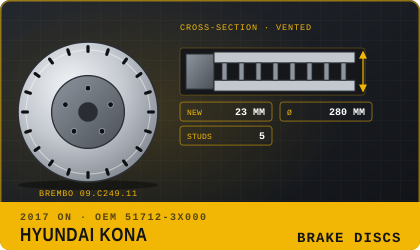 Illustration for editorial purposes
Opens live listings in a new tab.
OEM Part Number: 51712-3X000
Genuine front disc, confirm via VIN. Aftermarket front discs: Brembo 09.C249.11 / Bosch 0 986 479 A12
| Front brake discs (aftermarket) | Brembo 09.C249.11 (280 x 23 mm, vented, 5 holes, coated, high-carbon, min 21.4 mm); Bosch 0 986 479 A12 (280 x 23 mm, vented, 5 holes, oiled, min 21.4 mm); Brembo 09.D428.11 (305 x 25 mm, vented, 5 holes, coated, high-carbon, min 23.4 mm); Bosch 0 986 479 E42 (305 x 25 mm, vented, 5 holes, coated, high-carbon, min 23.4 mm); ATE 24.0125-0213.1 (305 x 25 mm, vented, 5 holes, coated, high-carbon, min 23.4 mm); Brembo 09.C245.11 (320 x 28 mm, vented, 5 holes, coated, high-carbon, min 26.4 mm); ATE 24.0128-0258.1 (320 x 28.1 mm, vented, 5 holes, coated, high-carbon, min 26.4 mm). |
|---|---|
| Disc sizes & variants | 280 x 23 mm vented on the 1.0 T-GDi; 305 x 25 mm vented on the 1.6 T-GDi, 1.6 CRDi and hybrid; 320 x 28 mm vented on the Kona Electric and 4WD versions. Rear discs are 262 or 284 mm solid. |
| Genuine (OE) numbers quoted | 51712-3X000 (genuine front disc number for this model — confirm via VIN, as several disc sizes exist) |
| Fitment notes | Minimum thickness is 21.4 mm (280 mm), 23.4 mm (305 mm) and 26.4 mm (320 mm); the 305 and 320 mm discs are shared with the i30 and ix35/Tucson respectively. |
What a vibrating wheel under braking usually means
If you've been told your discs have "warped" and are experiencing recurring vibration, this has been documented as a widespread design issue affecting Hyundai and Kia models broadly, where the brake pads themselves can get stuck inside the caliper bracket rather than moving freely. This causes uneven contact between pad and disc, producing vibration typically blamed on a "warped" disc. Lightly grinding down the small tabs on the back of the pad and applying appropriate brake grease allows the pad to move more freely.
Rear discs commonly corrode more than the fronts on many cars simply because the rear brakes experience less pressure during normal driving.
Watch: replacing themUS-market first-gen Kona.
How the rotors turn speed into heat on the Kona
On the Hyundai Kona, it's a paired system: let either one wear too far and the other suffers for it, which is why so many "just a pad change" jobs end up including discs once a mechanic actually looks.
Turning motion into heat
Brake discs provide the surface the brake pads clamp against to slow the car, converting momentum into heat through friction. Larger, sportier trims of the Kona typically use bigger discs than standard versions to handle the additional heat generated by more aggressive braking.
Opens live listings in a new tab.
These are the same regardless of make or model — see our full Brake Discs Guide for warning signs to watch for, confirming fitment against your VIN, and choosing a reliable aftermarket disc.
The same part on other modelsThe same part, covered across other Hyundai models.