
Toyota Auris Rear Springs: Specs, Fitment & Common Faults
Confirmed directly in Toyota's own parts catalogue: left and right rear coil springs are separate parts, not a single item fitted either side.
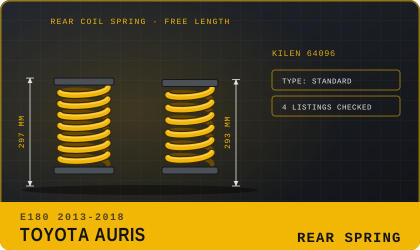 Illustration for editorial purposes
Opens live listings in a new tab.
OEM Part Number: confirm via VIN
Aftermarket coils: Kilen 64096 / Monroe SP5238
| Rear coil springs (aftermarket) | Kilen 64096; Monroe SP5238 (297 mm); Sachs 994518 (standard, 293 mm); Suplex 35489 (293 mm) |
|---|---|
| Genuine (OE) numbers quoted | None quoted in the catalogue listings — the genuine spring varies by engine, suspension type and body style, so order it against your VIN |
| Standard trims, lower right | a different part number from the lower-left spring — confirm side before ordering |
| Standard trims, lower left | A different reference from the lower-right spring above |
| Sport-trim spring, where fitted | A different, stiffer spring from standard trims |
Fitting the Toyota Auris's rear springs one at a time tends to backfire: pairing a fresh spring with a sagged original on the other side leaves the car sitting unevenly and biases handling to one side.
Side-specific coils on the Auris
Worth knowing: Toyota's own parts catalogue lists rear coil springs as lower-left and lower-right references — distinct, non-interchangeable parts rather than a single spring fitted to either side.
A clunk over bumps: broken coils
A rear spring often sags gradually for months without an obvious symptom beyond a slightly lower ride height, then fails suddenly at the coil's end with an audible clunk — worth bearing in mind if you notice one rear corner sitting lower than the other. Toyota's own guidance notes that coil springs aren't especially prone to failure under normal use, but cutting, clamping, or heating a spring compromises it and can lead to premature failure.
This video is of an earlier generation of the same model; the job is similar but the spring seats and fixings can differ slightly.
Carrying the load
The Toyota Auris's rear coil spring carries the weight of the car's back end and takes the first hit from any bump, working alongside — not instead of — the shock absorber. Once it sags or breaks, expect a lower ride height, possible headlight aim issues, and in severe cases, an MOT failure.
Opens live listings in a new tab.
These are the same regardless of make or model — see our full Rear Springs Guide for symptoms of a failing spring, confirming fitment against your VIN, and OEM vs aftermarket guidance.
The same part on other modelsThe same part, covered across other Toyota models.