
Toyota Prius Rear Shock Absorber: Specs, Fitment & Common Faults
Worth knowing: hybrid and non-hybrid versions sometimes share the same rear shock, and sometimes don't — Toyota's own parts catalogue isn't fully consistent across generations.
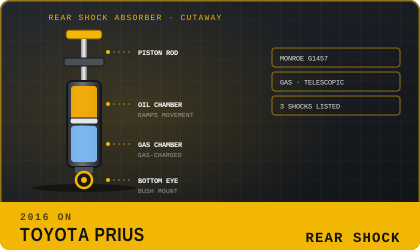 Illustration for editorial purposes
Opens live listings in a new tab.
OEM Part Number: confirm via VIN
Aftermarket rear dampers: Monroe G1457 / Kamoka 2001213
| Rear shock absorbers (aftermarket) | Monroe G1457 (gas, telescopic); Kamoka 2001213 (gas, telescopic); Abakus 232-02-348 (gas, telescopic) |
|---|---|
| Genuine (OE) numbers quoted | None quoted in the catalogue listings — the genuine damper varies by engine, suspension type and body style, so order it against your VIN |
| Non-hybrid, right | a different part number from the left-side shock, and potentially from the hybrid version below — confirm side and powertrain before ordering |
| Non-hybrid, left | A different reference from the right-side shock above |
| Hybrid, where distinct from non-hybrid | Confirm via VIN — some generations share references between hybrid and non-hybrid, others use a hybrid-specific part |
For consistency, it's best to replace the Toyota Prius's shock absorbers in pairs even if only one side has visibly failed.
Two sides, two part numbers on the Prius
Worth knowing: Toyota's own parts catalogue lists left and right rear shock absorbers as distinct, non-interchangeable references — not a single part fitted to either side. Where AWD is offered on this model, AWD and front-wheel-drive versions also use different rear shocks, reflecting the different rear subframe and driveline layout.
How fading dampers change the way the Prius drives
On the Toyota Prius, front suspension tends to get most of the attention since it also handles steering, but the rear shock absorbers wear too — often more subtly, with symptoms that are easy to write off as road noise until they get worse.

What the dampers at the back of the Prius actually do
The Toyota Prius's rear shock absorber controls how quickly the rear suspension compresses and rebounds over bumps, working independently of the coil spring. A worn rear shock lets the back of the car bounce excessively after a bump instead of settling quickly.
Opens live listings in a new tab.
These are the same regardless of make or model — see our full Rear Shock Absorber Guide for symptoms of a worn shock, confirming fitment against your VIN, and OEM vs aftermarket guidance.
The same part on other modelsThe same part, covered across other Toyota models.