
Audi Q5 Brake Discs: Specs, Fitment & Wear Symptoms
On the Q5, what's commonly called "warped discs" is almost always uneven pad deposits on related models, not physical warping.
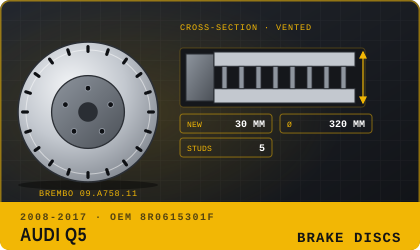 Illustration for editorial purposes
Opens live listings in a new tab.
OEM Part Number: 8R0615301F
Genuine front disc, confirm via VIN. Aftermarket front discs: Brembo 09.A758.11 / Bosch 0 986 479 753
| Front brake discs (aftermarket) | Brembo 09.A758.11 (320 x 30 mm, vented, 5 holes, coated, high-carbon, min 28 mm); Bosch 0 986 479 753 (320 x 30 mm, vented, 5 holes, coated, high-carbon, min 28 mm); ATE 24.0130-0221.1 (320 x 30 mm, vented, 5 holes, coated, high-carbon, min 28 mm, with bolts); TRW DF6148 (320 x 30 mm, vented, 5 holes, black painted); Zimmermann 100.3355.52 (320 x 30 mm, vented, 5 holes, Sport Coat Z coated, high-carbon, drilled, min 28 mm); Brembo 09.B970.11 (345 x 30 mm, vented, 5 holes, coated, high-carbon, min 28 mm, with bolts); Bosch 0 986 479 747 (345 x 30 mm, vented, 5 holes, coated, high-carbon, min 28 mm); ATE 24.0130-0222.1 (345 x 30 mm, vented, 5 holes, coated, high-carbon, min 28 mm, with bolts) |
|---|---|
| Disc sizes & variants | Two main front sizes, 320 mm and 345 mm (a 314 x 25 mm Ridex disc is also listed). The 320 x 30 mm disc is the standard fitment on the 2.0 TDI and 2.0 TFSI cars, and the 345 x 30 mm disc goes on the 3.0 TDI, 3.0 TFSI and SQ5 cars. |
| Genuine (OE) numbers quoted | 8R0615301F (genuine front disc number for this model — confirm via VIN, as several disc sizes exist) |
| Fitment notes | Minimum thickness is 28 mm for both the 320 mm and 345 mm discs; Brembo quotes 120 Nm wheel bolt torque. The drilled Brembo 09.B970.1X (345 mm) is also listed. Ridex 82B0270 (314 mm) and 82B0744 (320 mm) are uncoated budget discs limited to cars built up to November 2016. |
Why worn rotors undo new pads on the Q5
On the Audi Q5, because discs and pads wear as a pair, neglecting one speeds up wear on the other — which explains why a routine pad change so often turns up discs that are further gone than expected.
8R generation, discs and pads
What each rotor does when the Q5 brakes
Brake discs provide the surface the brake pads clamp against to slow the car, converting momentum into heat through friction. Larger, sportier trims of the Q5 typically use bigger discs than standard versions to handle the additional heat generated by more aggressive braking.
Opens live listings in a new tab.
Pulsing through the pedal on the Q5: the real cause
If you're facing a vibration under braking that's been diagnosed as warped discs, among experienced Audi owners, there's a widely repeated consensus that true disc warping is actually quite rare, with the vibration almost always caused by uneven pad material deposits on the disc surface instead. It's worth trying braking firmly from around 70mph down to 10mph, repeated several times without letting ABS intervene, to remove this build-up before assuming discs need replacing.
Bear in mind that a dealer refusing warranty cover for a brake disc issue, citing ordinary wear, has in documented cases been overturned by escalating directly to the manufacturer's UK customer service.
Wear symptoms, DIY difficulty and aftermarket adviceThese are the same regardless of make or model — see our full Brake Discs Guide for warning signs to watch for, confirming fitment against your VIN, and choosing a reliable aftermarket disc.
The same part on other modelsThe same part, covered across other Audi models.