
Hyundai Santa Fe Radiator: Specs, Fitment & Common Faults
On the Santa Fe, a leak from the weep hole near the A/C compressor points toward a failing water pump seal.
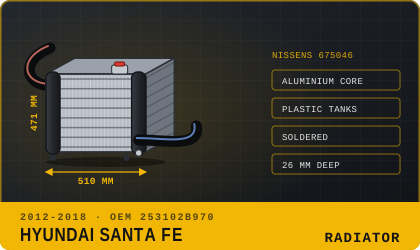 Illustration for editorial purposes
Opens live listings in a new tab.
OEM Part Number: 253102B970
As quoted in catalogue listings, confirm via VIN. Aftermarket units: Nissens 675046 / Valeo 701363
| Radiators (aftermarket) | Nissens 675046 (510 x 471 x 26 mm, soldered aluminium core, plastic tanks, with built-in oil cooler, fits 2.0 CRDi 150/185 PS D4HA and 2.2 CRDi 197 PS D4HB, 2WD and 4WD); Valeo 701363; NRF 53168; Van Wezel 82002339. |
|---|---|
| Core sizes & variants | One radiator covers all the UK diesel engines; it has 35 mm hose connections and an integral transmission oil cooler, so it suits the automatic. |
| Genuine (OE) numbers quoted | 253102B970; 253102B990 |
| Fitment notes | Supplied with gaskets and seals. The same part also fits the late Santa Fe II (CM) diesels. |
Pinpointing exactly where coolant is leaking
If you're trying to pin down exactly where a coolant leak is coming from, a leak from the small weep hole in the engine block near the A/C compressor points toward a failing water pump seal rather than a more general leak elsewhere.
Also, the thermostat housing sits toward the front of the engine, higher up than where normal AC condensation would appear — worth checking this specific area if you're unsure whether water underneath the car is genuine coolant or harmless condensation.
Keeping the Santa Fe's engine at the right temperature
Unglamorous as it is, the Hyundai Santa Fe's cooling system sits behind nearly every serious engine failure that isn't just ordinary wear — and one that went unaddressed for too long. Noticing early warning signs here is a small cost against a potentially very large one.
Watch: replacing itGeneration not stated in title; the only clearly dated alternative is the 2005-2010 older gen (BmHM5E9Blk0).
Pressure, temperature and the Santa Fe's coolant
On the Hyundai Santa Fe, engine coolant sheds its heat into the passing air via the radiator, which is what keeps engine temperature in a safe working range. On automatics, it frequently pulls double duty cooling the transmission fluid through its own internal circuit — a detail that makes getting the exact part number right especially important.
Opens live listings in a new tab.
These are the same regardless of make or model — see our full Radiator Guide for the three common failure modes, confirming fitment against your VIN, and OEM vs aftermarket guidance.
The same part on other modelsThe same part, covered across other Hyundai models.