
Hyundai Tucson Radiator: Specs, Fitment & Common Faults
A leak from the weep hole near the A/C compressor points toward a failing water pump seal — plus why checking the timing belt tensioner matters even after a recent pump replacement.
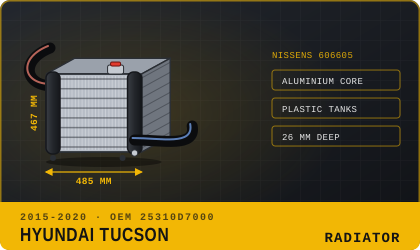 Illustration for editorial purposes
Opens live listings in a new tab.
OEM Part Number: 25310D7000
As quoted in catalogue listings, confirm via VIN. Aftermarket units: Nissens 606605 / Valeo 701140
| Radiators (aftermarket) | Nissens 606605 (485 x 467 x 26 mm, aluminium core, plastic tanks, 35 mm connections, supplied with seals, fits 1.6 CRDi D4FE, 1.7 CRDi D4FD, 2.0 CRDi D4HA and 1.6 T-GDi G4FJ including AWD and 48V versions); Valeo 701140; Denso DRM41031; NRF 550221; Mahle CR 1978 000P; Ava KA2350; Van Wezel 82012742; Magneti Marelli 350213204900. Nissens 606603 (635 x 467 x 16 mm, aluminium core, plastic tanks, 35 mm connections, fits 1.6 GDi G4FD and 2.0 petrol G4NA) |
|---|---|
| Core sizes & variants | Turbo engines (all diesels and the 1.6 T-GDi) use the 26 mm-thick 485 mm core; the normally aspirated 1.6 GDi and 2.0 petrol use a wider but thinner 635 x 16 mm core. |
| Genuine (OE) numbers quoted | Turbo/diesel: 25310D7000; 25310D7050. Non-turbo petrol: 25310D7500; 25310D7550 |
| Fitment notes | The diesel radiator is sold with seals but without the expansion tank or frame |
Where the Tucson's coolant leak is coming from
If you're trying to pin down exactly where a coolant leak is coming from, a leak from the small weep hole in the engine block near the A/C compressor points toward a failing water pump seal rather than a more general leak from a hose or the radiator itself. This specific location is deliberately designed to show early signs of a failing pump seal before it becomes a larger problem, so finding coolant here is a fairly reliable, specific sign of what actually needs replacing.
Also, the thermostat housing, commonly made from plastic on many models, sits toward the front of the engine, higher up than where normal air conditioning condensation would appear — worth checking this specific area directly if you're seeing what looks like water underneath the car but aren't certain whether it's coolant or simply harmless AC condensation.
Heat, coolant and the Tucson's engine life
Few parts get less attention than this one, but on the Hyundai Tucson, a neglected cooling system is behind the vast majority of avoidable serious engine failures. Noticing the early warning signs costs nothing and can save a large repair bill down the line.
Watch: replacing itIx35/LM-generation Tucson; only hose-connector videos exist for 2015-2020 TL
Core, fins and fan: the Tucson's cooling explained
On the Hyundai Tucson, coolant runs through the radiator to shed engine heat into the airflow, keeping temperatures in check. On many automatics, a separate internal circuit inside the same unit also cools the transmission fluid — one more reason a mismatched part number causes more than just a cooling problem.
Opens live listings in a new tab.
These are the same regardless of make or model — see our full Radiator Guide for the three common failure modes, confirming fitment against your VIN, and OEM vs aftermarket guidance.
The same part on other modelsThe same part, covered across other Hyundai models.