
Toyota Auris Fuel Pump: Specs, Fitment & Common Faults
On the Auris, Toyota has issued multiple genuine fuel pump recalls in recent years — worth checking your specific VIN directly.
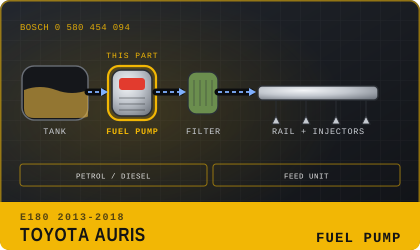 Illustration for editorial purposes
Opens live listings in a new tab.
OEM Part Number: confirm via VIN
Aftermarket units: Bosch 0 580 454 094 / Hüco 132734
| Fuel pumps / feed units (aftermarket) | Hüco 132734 (complete feed unit with sender, petrol); Delphi FE0670-12B1 (bare in-tank pump, petrol, metal housing); Bosch 0 580 454 094 (bare in-tank pump); Engitech ENT100247 (complete feed unit, 3.2 bar, 4-pin, 12 V 4.3 A, 118 x 370 mm); Meat & Doria 76416 (bare in-tank pump, 3 bar / 95 l/h, OE 170429F500); ERA 770162A (bare in-tank pump, 3.2 bar / 120 l/h, 2-pin, 38 mm body); Ridex 458F0040 (bare in-tank pump, 3.4 bar / 100 l/h, 2-pin, with mounting kit) |
|---|---|
| Types & variants | Two complete petrol feed units with sender are listed (Hüco 132734 and Metzger 2250696, both 4-pin), alongside the Engitech ENT100247 module. The rest are bare cartridges, plus a rubber Original Imperium 4018 pre-supply pump. No diesel feed unit is listed for the D-4D engines, and nothing is marked for the 1.8 hybrid. |
| Genuine (OE) numbers quoted | 170429F500 (Meat & Doria 76416, Hoffer 7506416); 3111137300 (Meat & Doria 76385, Hoffer 7506385); 142504 (Kamoka 8410016); 8450008680 (Kamoka 8410005) |
| Fitment notes | Petrol and hybrid Auris use an in-tank module with 4-pin connector and integral level sender; a complete unit replaces the sender, while a cartridge fitted into the original housing keeps it. The D-4D diesels use a separate lift pump arrangement, so a petrol module is not the right part for them. |
A recall check worth doing on the Auris
Toyota and Lexus have issued multiple genuine, official fuel pump recalls across various models since around 2020, related to an underlying pump design issue that can cause worn or damaged components inside the high-pressure fuel pump, with a real risk of fuel leak or engine stalling in the worst cases. It's worth checking your specific VIN against Toyota's official recall checker directly, rather than assuming a notice would definitely have reached you, particularly on a used car or one bought from a previous owner who may have moved address.
Bear in mind that a clean check for one specific recall doesn't guarantee there are no other open recalls affecting your exact build — checking the full list against your VIN rather than a single recall in isolation is worth doing periodically, particularly after buying a used car.
Why a sudden non-start on the Auris often means the pump
On the Toyota Auris, few component failures are as inconveniently timed as this one — it has a habit of stranding drivers mid-journey rather than giving a clean warning while the car is safely parked. Knowing the early signs buys valuable time to get it sorted before that happens.
Watch: replacing itPrevious-gen Corolla/Auris E150; no E180 pump video found
The Toyota Auris's fuel pump draws fuel from the tank and delivers it to the engine at the pressure required for proper combustion. Almost all modern versions sit inside the fuel tank itself, submerged in fuel, which is partly why access for replacement is more involved than the part's small size might suggest.
Which unit each Auris engine uses
| E15 (2006–2012) & E18 (2012–2018), all petrol incl. hybrid | Petrol: typically a single in-tank low-pressure pump; some later or higher-output variants may add a separate engine-mounted high-pressure pump for direct injection — confirm your exact engine — the hybrid system doesn't change this; the combustion engine still needs its own fuel pump |
|---|---|
| E15/E18, 1.4 D-4D (1ND-TV) & 2.0/2.2 D-4D (1AD-FTV/2AD-FHV) diesel | Diesel: in-tank lift pump feeds a separate engine-mounted high-pressure injection pump (common rail) — never interchangeable with the petrol pump |
Opens live listings in a new tab.
These are the same regardless of make or model — see our full Fuel Pump Guide for symptoms to watch for (including the low-pressure vs high-pressure distinction on direct-injection engines), confirming fitment against your VIN, and OE suppliers worth knowing.
The same part on other modelsThe same part, covered across other Toyota models.