
Toyota Yaris Fuel Pump: Specs, Fitment & Common Faults
On the Yaris, Toyota has issued multiple genuine fuel pump recalls in recent years — worth checking your specific VIN directly.
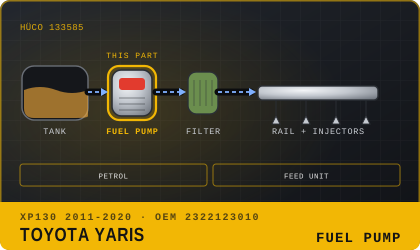 Illustration for editorial purposes
Opens live listings in a new tab.
OEM Part Number: 2322123010
As quoted in catalogue listings, confirm via VIN. Aftermarket units: Hüco 133585 / Delphi FE0795-12B1
| Fuel pumps / feed units (aftermarket) | Hüco 133585 (complete feed unit with sender, petrol); Hüco 133260 (complete feed unit with sender, petrol); Hüco 132728 (complete tank feed unit with sender, petrol); Hüco 133191 (pump module, petrol, no sender stated); Delphi FE0795-12B1 (pump module, petrol, metal, without pressure sensor); Delphi FE0670-12B1 (bare in-tank pump, petrol, metal housing); Meat & Doria 76393 (bare in-tank pump, 3.5 bar / 60 l/h, OE 2322123010); Metzger 2250699 (in-tank feed unit with sender, 4-pin, OE 770200D130). |
|---|---|
| Types & variants | The petrol Yaris is served two ways: complete feed units with the fuel gauge sender built in (Hüco, Metzger), or bare pumps and pump modules that go into the original housing (Delphi, Meat & Doria, Ridex, ERA). Blue Print ADBP680008 is a bare pump with strainer, 2-pin. |
| Genuine (OE) numbers quoted | Meat & Doria 76393 quotes 2322123010 (Toyota); Metzger 2250699 quotes 770200D130 (Toyota); Meat & Doria 76385 and Hoffer 7506385 quote 3111137300; Meat & Doria 76416 and Hoffer 7506416 quote 170429F500; Kamoka 8410005 quotes 8450008680. |
| Fitment notes | Petrol only in practice. A bare 38 mm pump such as the Meat & Doria 76393 fits into the original Yaris tank module and keeps the existing sender, which is the cheaper route if the fuel gauge still reads correctly; a complete feed unit replaces the sender and float too, which matters when the gauge has become erratic. The 4-pin connector on the complete units carries both pump and sender wiring. |
Whether the Yaris is covered by a fuel system recall
Toyota and Lexus have issued multiple genuine, official fuel pump recalls across various models since around 2020, related to an underlying pump design issue that can cause worn or damaged components inside the high-pressure fuel pump, with a real risk of fuel leak or engine stalling in the worst cases. It's worth checking your specific VIN against Toyota's official recall checker directly, rather than assuming a notice would definitely have reached you, particularly on a used car or one bought from a previous owner who may have moved address.
Also, a clean check for one specific recall doesn't guarantee there are no other open recalls affecting your exact build — checking the full list against your VIN rather than a single recall in isolation is worth doing periodically, particularly after buying a used car.
Low-fuel driving and pump wear on the Yaris
Rather than failing conveniently while parked, this component on the Toyota Yaris tends to give up mid-journey, which is about the worst possible moment. Learning to recognise the early symptoms is the best defence against being caught out.
Watch: replacing it1.5 Hybrid is XP130; removal plus pre-filter
The Toyota Yaris's fuel pump function — pulling fuel from the tank and pressurising it for the engine — is straightforward, but its usual location isn't: it sits submerged inside the tank itself, which is precisely why access for replacement is more work than the part's size suggests.
How pump design differs across Yaris engines
| Pre-2020 generations, petrol | Petrol: typically a single in-tank low-pressure pump; confirm your exact engine |
|---|---|
| 2001–2019, 1.4 D-4D diesel | Diesel: in-tank lift pump feeds a separate engine-mounted high-pressure injection pump (common rail) — never interchangeable with the petrol pump. Toyota's diesel Yaris was withdrawn from the UK range as the hybrid became the dominant efficient option. |
| Current generation (2020–present), hybrid, petrol only — no diesel offered | Petrol/hybrid: single in-tank low-pressure pump — the hybrid system doesn't change this; the combustion engine still needs its own fuel pump |
Opens live listings in a new tab.
These are the same regardless of make or model — see our full Fuel Pump Guide for symptoms to watch for (including the low-pressure vs high-pressure distinction on direct-injection engines), confirming fitment against your VIN, and OE suppliers worth knowing.
The same part on other modelsThe same part, covered across other Toyota models.